

Ama Dablam is a technically enriching Mountain in the Khumbu region with 6,812 m above sea level. It offers mesmerizing mountain views and culture.
Ama Dablam Expedition Nepal
Trip Facts
Starts
Kathmandu
Ends
Kathmandu
Group Size
2-10
Activities
Peak Climbing/ Expedition
Best Time
March-may, Sept-Nov
It is a dream expedition for experienced climbers. They need prior experience for participating the Ama Dablam Expedition. Most mountaineers summit the Ama Dablam as an acclimatization for the Everest Expedition.
There are three summits of Ama Dablam,, this expedition will summit the middle part. The Southwest Ridge is the standard route, which includes the icy and rocky steep route. It is a climbing along the fixed ropes in most of the areas.
Highlights
- One of the most rewarding summit climbs in Nepal
- Experience the Sherpa culture
- Close-up views of Mt Everest, Lhotse, and Makalu
Difficulty & Requirements
- Strong Physical and Mental fitness
- High-altitude experience
- Rocky, icy, and mixed climbing experience
- Knowledge of using fixed ropes, crampons, and ice axes
You'll Explore It
Short Itinerary & Altitudes
Day 1:
Arrival in Nepal
Altitude: 1,400m
Day 2:
Rest Day
Altitude: 1,400m
Day 3:
Lukla flight and trek to Phakding Village
Altitude: 2,610m
Day 4:
Trek to Namche Bazaar
Altitude: 3,440m
Day 5:
Rest Day
Altitude: 3,440m
Day 6:
Trek to Debuche
Altitude: 3,820m
Day 7:
Trek to Pangboche Village
Altitude: 3,985m
Day 8:
Rest Day
Altitude: 3,985m
Day 9:
Trek to Ama Dablam Base Camp
Altitude: 4,600m
Day 10:
Trek to Advanced Base Camp
Altitude: 5,100m
Day 11:
Climbing Preparation
Altitude: 5,100m
Day 12:
Climb to Camp I
Altitude: 5,700m
Day 13:
Climb to Camp II touch and back to base camp
Altitude: 4,600m
Day 14:
Rest
Altitude: 4,600m
Day 15:
Rest
Altitude: 4,600m
Day 16:
Climb to Camp I. Overnight in Camp I
Altitude: 5,700m
Day 17:
Climb to Camp II. Overnight in Camp II
Altitude: 6,000m
Day 18:
Summit day and back to Camp II
Altitude: 5,700m
Day 19:
Descend to Base Camp. Overnight in base camp
Altitude: 4,600m
Day 20:
Rest
Altitude: 4,600m
Day 21:
Descend to Namche Bazaar. Overnight in Namche Bazaar
Altitude: 3,440m
Day 22:
Descend to Lukla. Overnight in Lukla
Altitude: 2,800m
Day 23:
Fly back to Kathmandu. Overnight in Kathmandu
Altitude: 1,400m
Day 24:
Final Departure
Ama Dablam Expedition Nepal Detailed Itinerary
Day 1
Arrival in Nepal
Our representative will pick you up from the airport at Kathmandu and transfer you to the hotel.
Altitude: 1,400m (4,593ft)
Day 2
Rest Day
This day is reserved especially for re-arranging the gears.
Altitude: 1,400m (4,593ft)
Meals: Breakfast
Accommodation: 3 star hotel
Day 3
Lukla flight and trek to Phakding Village
It takes almost 30 minutes to reach Lukla by flight. Then we will meet our other trekking crews and begin a trek to Phakding village.
Altitude: 2,610m (8,562ft)
Duration: 3 hours walk
Meals: Breakfast, Lunch, Dinner, and Seasonal Fruit
Accommodation: Tea House
Mode of Transportation: Plane
Day 4
Trek to Namche Bazaar
After having breakfast, the trek resumes. We will go ahead through the Sagarmatha National Park to witness the jungle flora and fauna. We will be walking on a long suspension bridge as well, just before Namche Bazaar.
Altitude: 3,440m (11,286ft)
Duration: 7 hours
Meals: Breakfast, Lunch, Dinner, and Seasonal Fruits
Accommodation: Tea House
Day 5
Rest Day
This is an acclimatization day. We will look around the major city of Everest region i.e. Namche Bazaar.
Altitude: 3,440m (11,286ft)
Meals: Breakfast, Lunch, Dinner, and Seasonal Fruit
Accommodation: Tea House
Day 6
Trek to Debuche
The trek continues to Debuche by passing a beautiful village, Tengboche, where we can explore the oldest Tengboche Monastery. Finally, we will reach Debuche by witnessing the mountain views en route.
Altitude: 3,820m (12,532ft)
Duration: 7 hours
Meals: Breakfast, Lunch, Dinner, and Seasonal Fruit
Accommodation: Tea House
Day 7
Trek to Pangboche Village
From today, our trail leaves the Everest Base Camp Trek route. It is an easy trail till Dudh Koshi river. After crossing a suspension bridge, the gradual ascending begins. Along with walking, we will leave the views of Everest view hotel, tengboche village, Numer Himal ranges, Thamserku, Kusum Kangaroo, and Amadablam.
After trekking through the rhododendron forest, we reach Pangboche which offers the same views that we have seen during walking.
Altitude: 3,985m (13,074ft)
Duration: 2 hours
Meals: Breakfast, Lunch, Dinner, and Seasonal Fruit
Accommodation: Tea House
Day 8
Rest Day
This is another day for acclimatization. So, we will be engaging in the hiking activity for about 4 hours at an elevation of 300 m climb and explore the Tabuche Himal.
Altitude: 3,985m (13,074ft)
Meals: Breakfast, Lunch, Dinner, and Seasonal Fruit
Accommodation: Tea House
Day 9
Trek to Ama Dablam Base Camp
In the morning, our journey continues to Amadablam Base Camp. So, we will descend and cross an iron bridge again over the Dudh Koshi River. We will climb and again cross an iron bridge, offering the river view, Thamserku, Cholatse, Lobuche, Pumori, Lhotse, Nuptse, Thukla Pass, Pheriche village, Zongla side lake, and Khumbela peak.
After crossing the Nepal Telecom Tower (NTC), we will reach Amadablam Base Camp and see the views of Tabuche Himal, Khamteka range, Kongmala Pass, and Khumbela Peak. We will have lunch at the base camp.
Behind the base camp, we can see the east Northen side-Hillary airport, where Hillary tried to establish an airport in his period
Altitude: 4,600m (15,091ft)
Duration: 4 hours
Meals: Breakfast, Lunch, Dinner, and Seasonal Fruit
Accommodation: Tent
Day 10
Trek to Advanced Base Camp
Today, we will go for a hike to the Advanced Camp. It offers the views of mingmala pass, rolwaling ranges, glaciers, amadablam camp 1 and camp 2.
It is a rocky trail. So, some clients practice with the summit shoes.
Altitude: 5,100m (16,732ft)
Duration: 4 hours
Meals: Breakfast, Lunch, Dinner, and Seasonal Fruit
Accommodation: Tent
Day 11
Climbing Preparation
From today, we will begin the climbing preparation session. So, we will be introduced to the climbing gear like summit shoes, harness, jumer, eight finger, and act guide. Our training will be on the rocky trail, ascending and descending. We will traverse with summit shoes in the tea houses area.
Altitude: 5,100m (16,732ft)
Duration: 2-3 hour practice
Meals: Breakfast, Lunch, Dinner, and Seasonal Fruit
Accommodation: Tent
Day 12
Climb to Camp I
Today, we will trek on the ridge trail at first and meet the fixed line area in order to reach Camp 1. So, some of the climbing gears require. The NTC network also works up to Camp 1. The views can be seen from the Camp are mingmala pass, thamserku, khamterga, base camp, khumjung, kongde, numer Himal, eastern part pond, and glacier.
Altitude: 5,700m (18,700ft)
Duration: 6 hours
Meals: Breakfast, Lunch, Dinner, and Seasonal Fruit
Accommodation: Tent
Day 13
Climb to Camp II touch and back to base camp
Today's trail is a bit difficult. It is a technical trail so, so we need to use the climbing harness set. Then, we will reach Camp II after jumaring almost 20 meters rope.
Camp II has a small space where only 4-5 tents can be adjusted. Everywhere is slopy. It offers the closer views of the same mountains offered by the Camp I. Then we will be descending from the same route.
Altitude: 4,600m (15,091ft)
Duration: 10 hours
Meals: Breakfast, Lunch, Dinner, and Seasonal Fruit
Accommodation: Tent
Day 14
Rest
Full rest (pangboche, hotel area visit on one's own for using wifi and bathing activity)
Altitude: 4,600m (15,091ft)
Meals: Breakfast, Lunch, Dinner, and Seasonal Fruit
Accommodation: Tent
Day 15
Rest
Full rest ( summit preparation)
Nepali: prepare food and other things
Climber: engage in the training activity
Altitude: 4,600m (15,091ft)
Meals: Breakfast, Lunch, Dinner, and Seasonal Fruit
Accommodation: Tent
Day 16
Climb to Camp I. Overnight in Camp I
We will reach Camp I via the same route.
Altitude: 5,700m (18,700ft)
Duration: 10 hours
Meals: Breakfast, Lunch, Dinner, and Seasonal Fruit
Accommodation: Tent
Day 17
Climb to Camp II. Overnight in Camp II
We will reach Camp II following the previous way.
Altitude: 6,000m (19,685ft)
Duration: 7 hours
Meals: Breakfast, Lunch, and Dinner
Accommodation: Tent
Day 18
Summit day and back to Camp II
We will begin our climbing very early almost at 11 pm after dinner. We will be climbing whole night in order to reach summit before wind begins. It is a steep walk. We need to step up technically because of the rock fall at mushroom ridge. We have walk very slowly because our leg may fight together.
Then we will reach Camp III after mushroom ridge where the camp will be set if needed. Otherwise, we will continue our expedition to amadablam.
Finally, we will reach at the middle summit of Amadablam and explore all the 8000ers including the Mt Everest. If the weather permits, we will spend almost one hour. Otherwise, we will descend to Camp I.
Altitude: 5,700m (18,700ft)
Duration: 20 hours
Meals: Breakfast, Lunch, and Dinner
Accommodation: Tent
Day 19
Descend to Base Camp. Overnight in base camp
We will be retracing to the base camp
Altitude: 4,600m (15,091ft)
Duration: 8 hours
Meals: Breakfast, Lunch, and Dinner
Accommodation: Tent
Day 20
Rest
This is a celebration day. So, we will take hot bucket shower first. Then pack our bags. Finally, we will celebrate our successful Ama dablam Expedition with opening the Champange.
Altitude: 4,600m (15,091ft)
Meals: Breakfast, Lunch, Dinner, and Seasonal Fruits
Accommodation: Tent
Day 21
Descend to Namche Bazaar. Overnight in Namche Bazaar
We will go down to Namche following the previous route.
Altitude: 3,440m (11,286ft)
Duration: 10 hours
Meals: Breakfast, Lunch, Dinner, and Seasonal Fruits
Accommodation: Tea House
Day 22
Descend to Lukla. Overnight in Lukla
We will reach Lukla through the same route.
Altitude: 2,800m (9,186ft)
Duration: 7 hours
Meals: Breakfast, Lunch, Dinner, and Seasonal Fruits
Accommodation: Tea House
Day 23
Fly back to Kathmandu. Overnight in Kathmandu
We will fly to Kathmandu along the same air route.
Altitude: 1,400m (4,593ft)
Meals: Breakfast and Farewell Dinner
Accommodation: 3 star hotel
Day 24
Final Departure
Our representative will leave you at the airport almost three hours before your flight schedule.
Meals: Breakfast
Need Help Planning?
Let our local experts plan your perfect journey across Nepal, Tibet, and Bhutan.
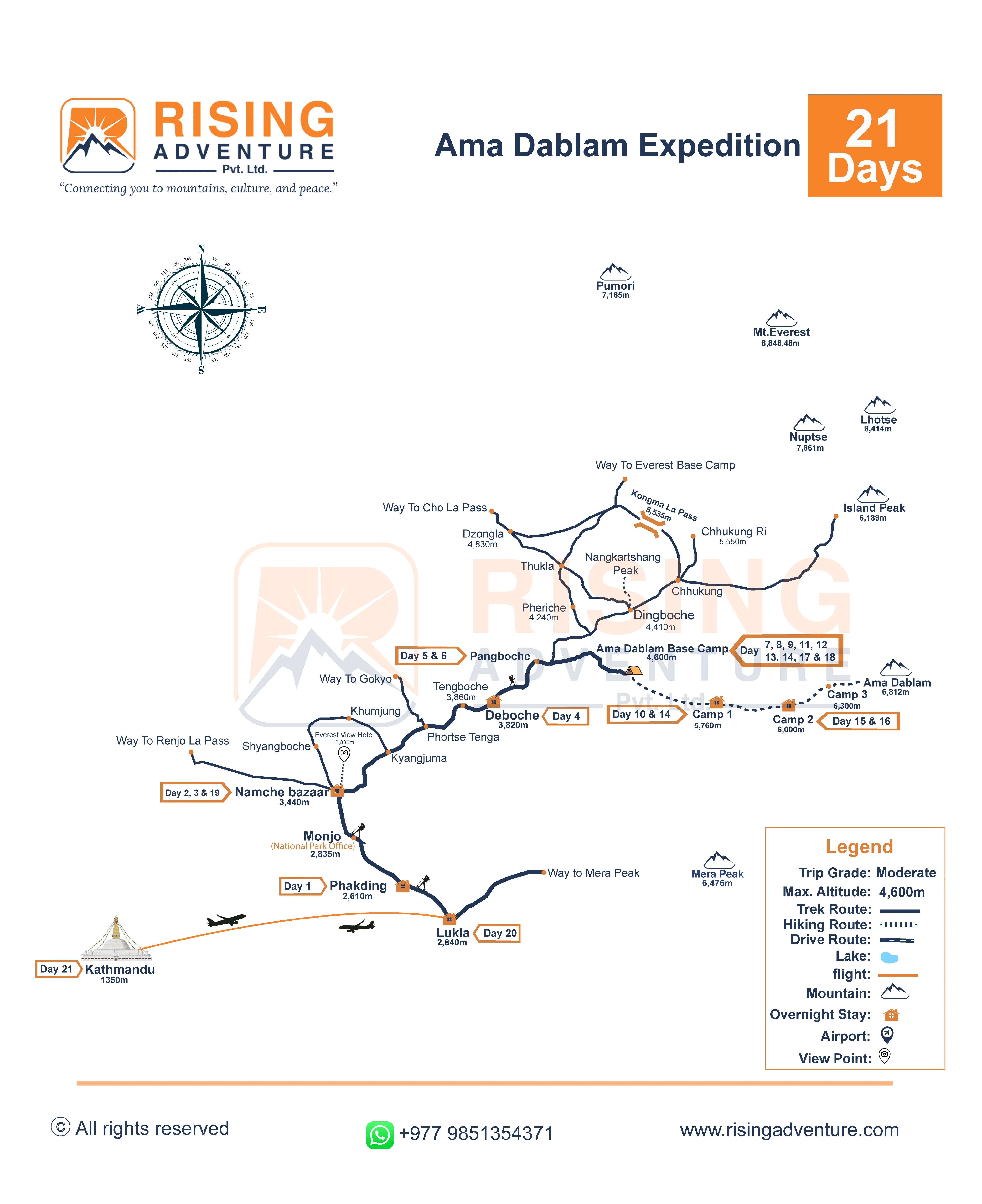
Map
Altitude Chart
Private Trip
Equipment Lists for Ama Dablam Expedition Nepal
Ama Dablam Expedition Gears
Below are the tentative lists of Ama Dablam Expedition equipment.
Upper Body Layers
- Outer Warmer Jacket
- Base layer Jacket
- Thermal wear
- Waterproof Rain Jacket
- Expedition Down Jacket
- Windproof jacket
- Insulated Jacket
- Trekking t-shirts
- Duvet Suit
- Gloves and Mitt Liners
Lower Body Layers
- Inner body and leg Thermal
- Rain Trousers
- Insulated trousers
- Thermal bottoms
- Fleece trousers
- Shorts
- Sports Underwear
Footwear & Accessories
- Mountaineering Boots
- Crampons
- Trekking Boots
- Slipper
- Gaiters
- Climbing Socks
- Poly Socks
- Down boot
- Running shoes
- Warm Thermal Socks
Head & Sun Protection
- Sun Hat
- Warm Beanie
- Warm Scarf
- Sunscreen
- Glacier Sunglasses
- Ski Goggles
- Balaclavas
- Climbing Helmet
- Eyes and nose cover
Personal & Medical Kits
- Medicine, if you are taking
- Water Purifier
- First Aid Kit (Our guide keeps)
Travel Documents
- Passport
- Nepal Visa
- Passport-size photos
- Travel Insurance
Miscellaneous
- Climbing Bag
- Duffel Bag (Rising Adventure provides)
- Light Day Bag
- Small Waist Money Purse
- Sleeping Bag
- Trekking Poles
- Ice Axe
- Harness
- Carabiners
- Climbing Ropes
- Ascenders and Descenders
- Headlight
- Folding Knife
- Binoculars
- Garbage bags
- Nylon sacks for food storage
- Water Bottle
- Earplug
- Towel
- Toilet Papers
- Waterproof Bag Cover
- Lock for Bags
- Lip Gloss
Essential Information
Best time for Mount Ama Dablam Expedition
The most appropriate times to summit Mount Ama Dablam are during spring (March-May) and the Autumn season(September-November). These seasons are characterized by stable weather, moderate temperatures, and clear blue skies with amazing Himalayan vistas. Such offerings present a greater chance of summiting the Ama Dablam peak compared to other seasons.
Meals and Accommodations during Ama Dablam Peak Climbing
The meals throughout the expedition will be hygienic, freshly prepared, and nourishing, which will provide the energy required to do the strenuous climb as well as trekking in the earlier part of the journey. Plenty of options of traditional Nepali, Indian, Tibetan, and some Western dishes are available in the menu options. The option will get limited and more basic as we reach higher elevations towards the Ama Dablam Base Camp and the advanced camp.
Similarly, the accommodations in the trekking portion of the expedition will be in the teahouse run by the local families in the Khumbu region. The room will be on a twin-shared basis and have basic bedding facilities. Similarly, from the base camp of Ama Dablam, your night stay will be in a tented camp on a twin-shared basis. Additional charges will be applied if you want a single room for yourself. Sleeping bag and foam mattress will be provided in the camps upon request.
Permits required for the Expedition
The necessary permits for Ama Dablam peak climbing are as follows:
- Peak climbing permits
- TIMS (Trekkers’ Information Management System) card
- Sagarmatha National Park Permit
- Khumbu Pasang Lhamu Rural Municipality Entrance Permit
Experience required for the Ama Dablam Expedition
The Ama Dablam Expedition involves technical climbing at a high altitude of about 6800 meters above sea level. To reach the Ama Dablam base camp, you also need to trek for several hours in the initial days.
Ama Dablam Expedition Difficulty
- Difficulty Level: Strenuous to Challenging
- Total Distance: around 120 km from Lukla to Ama Dablam base camp, round trip, and about 2.24 km from the base camp to the summit
- Walking and climbing hours: 5-7 hours of walking on trekking days, while climbing days take around 6-7 hours per day for the climbing rotation
- Geographical hurdles: Involves climbing in technical sections, strong winds, falling ice, and altitude gains of 6812 m at the summit of Ama Dablam
Physical Fitness and Preparation
- For Stamina and Fitness: Activities like cycling, swimming, hiking with a backpack, and running.
- For the upper body: Exercises like pull-ups, push-ups, and weight lifting for building up strength in the upper body
- For technical climbing: Practicing using crampons and an ice axe on an uphill terrain with full gears
- For core and leg strength: Perform exercises like lunges and squats.
- For flexibility: Do yoga and stretching exercises for flexibility and avoiding injury.
Who is suitable for the Ama Dablam Peak Climbing?
- Experienced mountaineers who have previous experience of peak climbing above 6000 meters, like Island Peak.
- Mountaineers must possess excellent technical skills with crampons, ice axes, ropes, ascenders, and descenders.
- One should have great tolerance to high altitude and be able to withstand extreme weather conditions (strong winds, snow, and cold temperatures).


We're Here to Help 24/7
Meet Your Local Experts
Creating unforgettable journeys across Nepal, Tibet, and Bhutan.
At Rising Adventure, we believe in connecting you to mountains, culture, and peace. As your trusted local travel partner, we create safe, authentic, and unforgettable trekking, climbing, and tour experiences across Nepal, Tibet, and Bhutan. With experienced local experts and personalised service, we're with you every step of your journey, from your first enquiry to your final departure, ensuring a smooth, memorable, and truly unforgettable experience of a lifetime.