
When you choose Rising Adventure, you are guaranteed to have a safe, comfortable, and enjoyable Everest and Gokyo trek. We will arrange your trekking permits and accommodations in cozy teahouses/lodges as well as provide you with nutritious food to ensure that your trek is a stress-free experience in the Khumbu and Gokyo valleys.
Everest and Gokyo Trek
Trip Facts
Duration
15 Days
Trip Grade
Level 3 - Intermediate
Country
Nepal
Maximum Altitude
5555 m
Starts
Kathmandu
Ends
Kathmandu
Group Size
2-10
Activities
Trekking
Best Time
March-May, Sept-Nov
Our guides are young, professional, and energetic, and possess profound local knowledge of the Everest region. They are quite friendly and also give you ample opportunities to learn about the culture and traditions of the Sherpa people.
The trekking itinerary to Everest Base Camp via the Gokyo Lakes is very well planned, and you will have plenty of time to acclimatize to the high altitude and appreciate the magnificent Himalayan vistas. Likewise, you can also customize your Everest Gokyo Lake trek according to your schedule and preferences.
At Rising Adventure, all the logistics and safety measures are taken care of, so that you can remain adventure-centric and fully enjoy your time in the Everest region.
The Everest Base Camp trek and Gokyo Lakes trek, also known as the Everest circuit trek, is a combination of the classic Everest Base Camp trek with the trek to the pristine Gokyo Lakes. The length of this Ebc Gokyo trek is usually 14-20 days, leading the trekkers to Gokyo and Khumbu Valleys. During the entire journey, you will witness great views of mountain peaks, turquoise glacial lakes, icefalls, and beautiful landscapes.
You'll Explore It
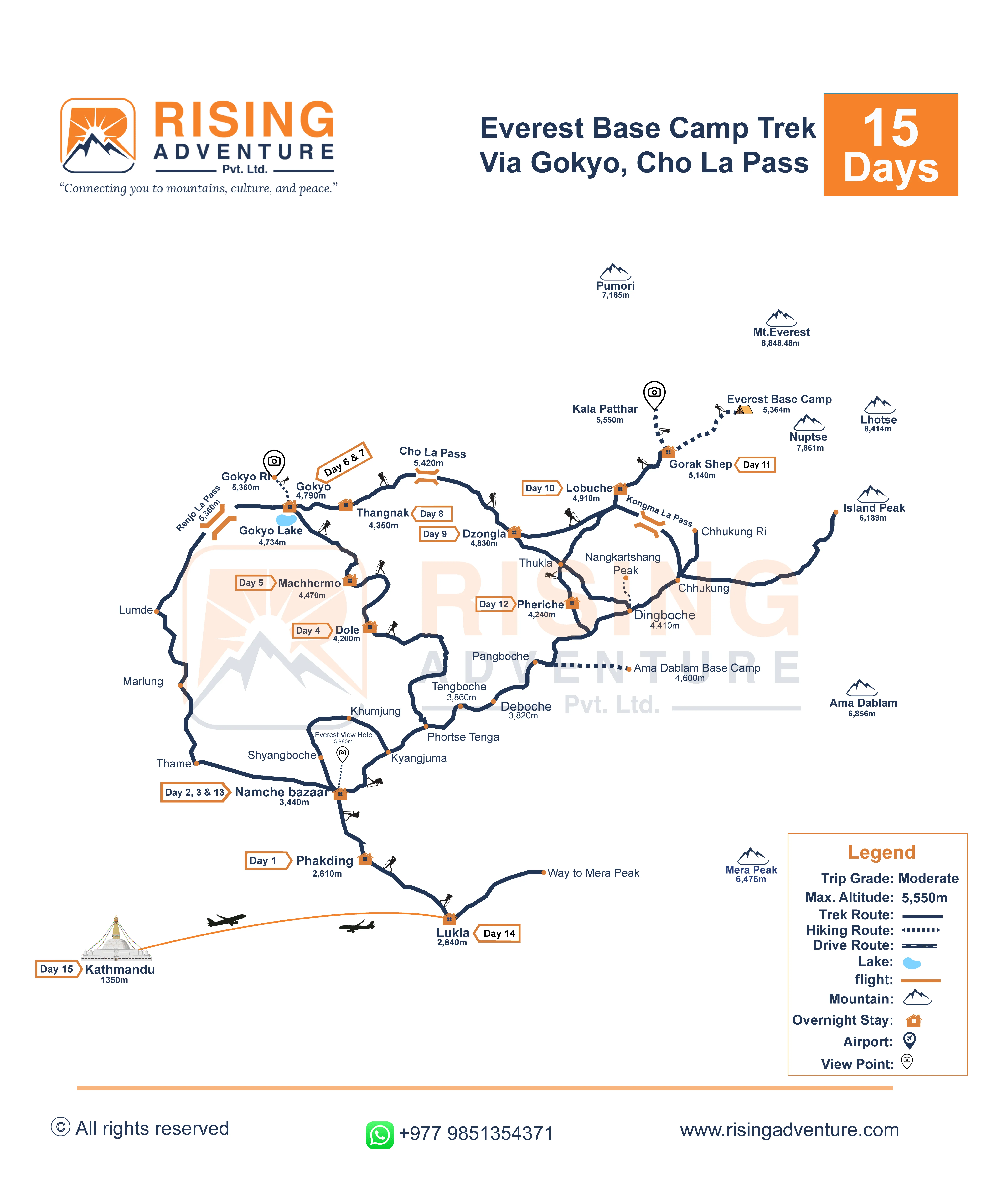
Short Itinerary & Altitudes
Day 1:
Flight from Kathmandu to Lukla and trek to Phakding
Altitude: 2,600m
Day 2:
Trek from Phakding to Namche Bazaar
Altitude: 3,440m
Day 3:
Acclimatization Day at Namche Bazaar
Altitude: 3,440m
Day 4:
Trek from Namche Bazaar to Dole
Altitude: 4,038m
Day 5:
Trek from Dole to Machhermo
Altitude: 4,470m
Day 6:
Trek from Machhermo to Gokyo
Altitude: 4,750m
Day 7:
Acclimatization Day and climb to Gokyo Ri
Altitude: 4,750m
Day 8:
Trek from Gokyo to Thangnak
Altitude: 4,350m
Day 9:
Trek from Thangnak to Dzongla through Cho La pass
Altitude: 4,830m
Day 10:
Trek from Dzongla to Lobuche
Altitude: 4,940m
Day 11:
Trek from Lobuche to Everest Base Camp and head to Gorak Shep
Altitude: 5,164m
Day 12:
Early Morning Hike to Kalapatthar and trek to Pheriche
Altitude: 4,371m
Day 13:
Trek from Pheriche to Namche Bazaar
Altitude: 3,440m
Day 14:
Trek from Namche Bazaar to Lukla
Altitude: 2,800m
Day 15:
Return flight to Kathmandu from Lukla
Altitude: 1,350m
Everest and Gokyo Trek Detailed Itinerary
Day 1
Flight from Kathmandu to Lukla and trek to Phakding
Our journey to the Everest Base Camp and Gokyo Lakes Trek begins with a scenic flight from Kathmandu to Lukla. After arriving at the Tenzing-Hillary airport in Lukla, our guide will assign you a porter upon your request. You will then embark on your way towards Phakding along the Dudh Koshi River.
Altitude: 2,600m (8,530ft)
Duration: 3 hours and 35 minutes
Meals: Breakfast, Lunch, Dinner, and Seasonal Fruits
Accommodation: Tea House
Mode of Transportation: Aero plane
Day 2
Trek from Phakding to Namche Bazaar
Today’s stop will be the bustling town of Namche Bazaar. En route, you will pass several suspension bridges painted with prayer flags. The path winds along the banks of the Dudh Koshi River and through the rhododendron forests. You will soon reach the Monjo Village. A short stroll beyond that will lead to the entrance of the Sagarmatha National Park (UNESCO World Heritage Site).
Then you will continue your adventure and finally arrive at Namche Bazaar, filled with trekkers and friendly local sherpas.
Altitude: 3,440m (11,286ft)
Duration: 7 hours
Meals: Breakfast, Lunch, Dinner, and Seasonal Fruits
Accommodation: Tea House
Day 3
Acclimatization Day at Namche Bazaar
On this day, you will have a rest day at Namche Bazaar. With that said, you won’t just be staying at one place the entire time. You will explore around the famous landmarks of Namche Bazaar, like the Khumjung Monastery and Hillary School, or go on a hike to Syangboche Airport and the Everest View Hotel.
This day also brings a perfect opportunity for you to experience the culture and lifestyles of the local Sherpas who reside in the area.
Altitude: 3,440m (11,286ft)
Meals: Breakfast, Lunch, Dinner, and Seasonal Fruits
Accommodation: Tea House
Day 4
Trek from Namche Bazaar to Dole
From Namche Bazaar, you are going to follow different route from the classic Everest Base Camp trek. The trail leads to the village of Kenjoma, where the paths of the classic EBC and Gokyo Lakes treks separate.
Then, you will be making your way to Mong La Pass, from where you will get impressive views of Mt. Ama Dablam, Mt. Thamserku, and other mountain peaks. From the pass, you will descend to reach Phortse Thenga village and will continue your journey until Dole. From there, you might even get a beautiful sunset view if you arrive there in time.
Altitude: 4,038m (13,248ft)
Duration: 7 hours
Meals: Breakfast, Lunch, Dinner, and Seasonal Fruits
Accommodation: Tea House
Day 5
Trek from Dole to Machhermo
You will make an ascent from Dole towards a ridge, which offers marvelous views of Mount. Cho Yu (the fifth tallest mountain in the world) and Kengtega. The trail will pass through the Lapahrma village and Luja village to finally arrive at Macchermo.
Altitude: 4,470m (14,665ft)
Duration: 6 hours
Meals: Breakfast, Lunch, Dinner, and Seasonal Fruits
Accommodation: Tea House
Day 6
Trek from Machhermo to Gokyo
Today, you will finally reach one of your destinations, the Gokyo Lakes. You will pass through the alpine pastures and reach Phanga, enjoying scenic views of Mount Kangtega, Thamserku, and Cho-Oyu. You will then traverse towards the moraines of Ngozumpa Glacier on a tricky trail.
Trekking further will take you to the Gokyo Lakes. You will be mesmerized by the beauty of the Gokyo Lakes System, a combination of 6 lakes. The renowned Gokyo Ri can also be seen lying in the middle of the Gokyo Valley.
Altitude: 4,750m (15,583ft)
Duration: 6 hours
Meals: Breakfast, Lunch, Dinner, and Seasonal Fruits
Accommodation: Tea House
Day 7
Acclimatization Day and climb to Gokyo Ri
You will go on a hike early in the morning to the Gokyo Ri (5,357 m). The view from the Gokyo Ri is absolutely out of this world. You will be rewarded with panoramic views of 4 of the 6 highest mountains in the world: Mount Everest (8,848 m), Lhotse (8,516 m), Makalu (8,485 m), and Cho-Oyu (8,188 m), as well as the beautiful Gokyo Valley, Gokyo Lakes, and the Ngozumpa Glacier.
You will then descend to the Gokyo village and have breakfast. For the rest of the day, you will roam around the Gokyo village and explore the lakes.
Altitude: 4,750m (15,583ft)
Duration: 3 hours
Meals: Breakfast, Lunch, Dinner, and Seasonal Fruits
Accommodation: Tea House
Day 8
Trek from Gokyo to Thangnak
You will be moving towards Thangnak, the foot of the Cho La Pass. The trail today will be full of ups and downs, but there won't be any altitude gain. En route, you will also pass by the Ngozumpa Glacier. Your stay at Thagnak will be very basic with communal lodging, as it is a very remote place.
Altitude: 4,350m (14,271ft)
Duration: 6 hours
Meals: Breakfast, Lunch, Dinner, and Seasonal Fruits
Accommodation: Tea House
Day 9
Trek from Thangnak to Dzongla through Cho La pass
The trek will start early in the morning at around 4 to 5 am, and you will reach the top of Cho La Pass around 10 am. From the pass, you get stunning views of Mount Cholatse (6,440 m) and Cho La Lake. You will then go downhill towards your destination of Dzongla, following a slippery and icy trail.
Altitude: 4,830m (15,846ft)
Duration: 10 hours
Meals: Breakfast, Lunch, Dinner, and Seasonal Fruits
Accommodation: Tea House
Day 10
Trek from Dzongla to Lobuche
Today’s trek will be a shorter and easier one towards Lobuche. The trek will just be about 4 to 5 hours. We will make our descent along the Cho La Lake and follow the Khumbu Glacier and Imja Khola to arrive at Lobuche.
Altitude: 4,940m (16,207ft)
Meals: Breakfast, Lunch, and Dinner
Accommodation: Teahouse
Day 11
Trek from Lobuche to Everest Base Camp and head to Gorak Shep
This day will be an important day as you will reach the Everest Base Camp with an elevation of 5,364 m. This is the closest you can get to the mighty Mount Everest without any mountain climbing equipment.
The trek will be a difficult one along the Khumbu Glacier. The path follows a steep ascent to Gorak Shep. You will leave all your belongings at Gorakshep and continue your journey towards the Everest Base Camp.
The feeling of reaching the Everest Base Camp will be very special and one you will never forget. You will get stunning views of the Khumbu Glacier from the base camp. After clicking many pictures and videos at the Everest base camp, you will return to Gorak Shep for our overnight stay.
Altitude: 5,164m (16,942ft)
Duration: 9 hours
Meals: Breakfast, Lunch, Dinner, and Seasonal Fruits
Accommodation: Tea House
Day 12
Early Morning Hike to Kalapatthar and trek to Pheriche
You will wake up early in the morning and hike to one of the famous viewpoints of the Everest region, Kalapatthar (5,555 m). The hike will follow a challenging ascent, but it can be achieved. From this viewpoint, you will be rewarded with the sunrise view over the mighty Mount Everest, the highest peak in the entire world. You will also get breathtaking mountain views of Lhotse, Pumori, Makalu, Ama Dablam, and many other peaks.
After enjoying your time and clicking many photos and videos from the Kalapatthar viewpoint, you will make your descent to Gorak Shep. At Gorakshep, you will have some rest, take breakfast, and head towards Pheriche.
Altitude: 4,371m (14,340ft)
Duration: 6 hours
Meals: Breakfast, Lunch, Dinner, and Seasonal Fruits
Accommodation: Tea House
Day 13
Trek from Pheriche to Namche Bazaar
Your descent journey continues further towards Namche Bazaar. The trail will pass along the dense rhododendron forests and beautiful settlements such as Tengboche, Somare, and Pangboche. You will also encounter several prayer flags and chortens along the way. Today will be your last opportunity to see the towering Mount Everest. By afternoon, you will arrive at Namche Bazaar, where you will be spending your night.
Altitude: 3,440m (11,286ft)
Duration: 6 hours
Meals: Breakfast, Lunch, Dinner, and Seasonal Fruits
Accommodation: Tea House
Day 14
Trek from Namche Bazaar to Lukla
This day will be your last day of trekking in the trails of the Khumbu region. You will make your way back to Monjo and walk alongside the Dudh Koshi River to arrive at Phakding and finally reach Lukla by the evening. During our spare time at Lukla, you will be celebrating your successful Everest Base Camp and Gokyo Lakes trek by dancing, having drinks, and enjoying delicious food.
Altitude: 2,800m (9,186ft)
Duration: 7 hours
Meals: Breakfast, Lunch, Dinner, and Seasonal Fruits
Accommodation: Tea House
Day 15
Return flight to Kathmandu from Lukla
You will fly back to Kathmandu with a 35-minute flight from the Tenzing-Hillary Airport. You can take a well-deserved rest at your hotel after arriving in Kathmandu. In the peak seasons, you might be taking a 20-minute flight to Manthali, and from there you will drive to your hotel in Kathmandu.
Altitude: 1,350m (4,429ft)
Duration: 35 minutes
Meals: Breakfast and Farewell Dinner
Accommodation: 3 star hotel
Mode of Transportation: Aeroplane and Private car
Need Help Planning?
Let our local experts plan your perfect journey across Nepal, Tibet, and Bhutan.
Map
Altitude Chart
Private Trip
Add-Ons & Options
This is an optional add-on to upgrade your trekking and is also helpful for time-limited trekkers.
- Direct Helicopter flight from Kathmandu to Lukla
Hiring either a private or a shared Helicopter helps you to get rid of the airport congestion and flight delays. It adds luxury to your journey.
- Fly back to Kathmandu by Helicopter from Gorakshep
Taking a flight from Gorakshep to Kathmandu after exploring the Everest region is a nice way to save vacation days and also see the Sagarmatha region from the sky.
- Lukla to Kathmandu flight by Helicopter
This option is best for flight cancellation due to weather conditions.
Equipment Lists for Everest and Gokyo Trek
EBC and Gokyo Lakes Trekking Gears
Below are the tentative lists of EBC and Gokyo Lakes trek equipment.
Upper Body Layers
- Outer Warmer Jacket
- Base layer Jacket
- Waterproof Rain Jacket
- Down Jacket
- Windproof jacket
- Fleece-type Jacket
- Trekking Shirt
- Inner windproof Thermal gloves
- Outer Gloves
Lower Body Layers
- Inner body and leg Thermal
- Rain Trousers
- Windproof pants
- Sports Underwear
Footwear & Accessories
- Hiking Boots
- Trekking Boots
- Gaiters
- Hiking Socks
- Warm Thermal Socks
Head & Sun Protection
- Sun Hat
- Warm Beanie
- Warm Scarf
- Sunscreen
- Sunglasses
Personal & Medical Kits
- Medicine, if you are taking
- First Aid Kit (Our guide keeps)
Travel Documents
- Passport
- Nepal Visa
- Two passport-size photos
- Travel Insurance
Miscellaneous
- Trekking Bag
- Duffel Bag (Rising Adventure provides)
- Light Day Bag
- Small Waist Money Purse
- Sleeping Bag (optional)
- Trekking Poles
- Headlight
- Water Bottle
- Towel
- Toilet Papers
- Waterproof Bag Cover
- Lock for Bags
- Lip Gloss
Essential Information
Meals for the Everest Base Camp and Gokyo Lakes Trek
Along the Everest Base Camp and Gokyo Lakes Trek, you will get a variety of options to choose from, which include Nepali, Tibetan, Indian, and continental dishes. In our trek package, you will be served 15 breakfasts, 15 lunches, and 15 dinners.
The most common dish throughout the trek will be local Dal Bhaat Tarkari (rice, lentils, and veggies). Dishes like momo (dumplings), noodles, and soups are also available during your trek. All the meals provided during the trek will be fresh, hygienic, and nutritious. If you follow a strict vegetarian diet, please let us know beforehand.
The options for breakfast include tea, coffee, Tibetan bread/chapati, pancakes, porridge, cereals, and eggs.
For your lunch and dinner, you can opt for Daal Bhat Tarkari with pickle and salads, noodles, fried rice, soup, momo (Tibetan dumplings), soup, spring rolls, pizza, sherpa stew, and spaghetti.
Drinks such as tea, coffee, hot chocolate, lemon with honey and ginger, and beer are available during the trek. You will be served one drink per meal. Any beverages not included in the meal plan will be at your own expense.
Accommodations during the Everest Base Camp Trek via Gokyo Lakes
Your stay along the Everest Base Camp Trek via Gokyo Lakes will be in teahouses/lodges run by local families. Most of the rooms will have twin beds, blankets, and pillows with shared or private bathrooms. There won’t be heaters in the bedroom, so bringing a sleeping bag with you is always a wise choice.
During your stay in Lukla and Namche Bazaar, you will have rooms with attached bathrooms. As you go higher, the rooms will be basic yet comfortable. In remote areas like Thangnak and Dzongla, you will be sleeping in dormitory-style rooms.
In most teahouses, there will be a dining hall, which is heated by yak dung cakes or fuel wood. You can gather there to get warmth in your evenings. You can have hot showers in many lodges, but you will need to pay extra fees for it.
Toilets in most of the teahouses are in a Western style. As you go to higher altitudes, you have to use squat-style toilets. WiFi and electronic device charging are also available in most teahouses, but come with an additional cost.
Best time to do the Everest Gokyo Lake Trek
The most appropriate seasons for the Everest Gokyo Lake trek are autumn (late September to November) and spring (March to May). These seasons are characterized by warm temperatures, clear skies, and the best visibility of the Himalayan views. However, you can still trek during other seasons.
Spring is probably the most ideal time to do the Everest Gokyo Lake Trek. The season presents lush forests with rhododendron blooms, clear mountain views, and pleasant weather. The average daytime temperature during this season is about 20°C and can reach -15°C at night in higher regions (above 4,000 m). The season is one of the busiest seasons for trekking in the Everest region. This season is perfect for trekkers who are nature lovers and want amazing Himalayan vistas.
During monsoon/summer (June to August), there will be heavy rainfalls in areas below 3500 meters. The season is not so ideal for trekking due to slippery and muddy trails. Many people do not prefer this season for trekking. Nonetheless, the trail is less crowded, and one can get the chance to see waterfalls during this season. The average daytime temperature in the monsoon season is 22°C and can reach -5°C at nighttime in high areas above 4000 m.
Autumn is also one of the most preferred seasons for the Everest Gokyo Lake Trek. This season offers wonderful Himalayan views at all the viewpoints, as it arrives after the monsoon rain. The average daytime temperature is about 17°C and can reach -15°C at nighttime in high-altitude areas.
The winter season also offers good visibility for the Himalayan views, but trekking can be difficult during this season due to heavy snowfall along the trails. On some days, the weather can also be cloudy, obstructing the views of the mountains. The trail is less crowded during this season, making it ideal for trekkers who want a tranquil trail. The nighttime temperature can reach up to -20°C in higher elevations. During this season, the teahouses also offer extra blankets for warmth at night.
Difficulty of the Everest Base Camp and Gokyo Lakes Trek
The Everest Base Camp and Gokyo Lakes Trek difficulty can be rated as moderate to challenging. Trekkers need to have great physical fitness and strong mental resilience to complete this trek. You are required to walk daily for 7-8 hours at a high altitude.
The trek reaches high elevation points like Kalapatthar (5,555 m) and Everest Base Camp (5,364 m), where there will be low oxygen. Trekkers can suffer from altitude sickness in these high-altitude regions. To prevent altitude sickness, one has to acclimatize properly, stay hydrated, and walk steadily.
Permits required for the trek
The two major permits needed for the trek are
- Sagarmatha National Park Entry Permit: This permit is required in order to travel inside the Sagarmatha National Park, which is a UNESCO World Heritage site. It will cost approximately NPR 3,000 per person for international travelers (discounts will be offered to citizens of SAARC members).
- Khumbu Pasang Lhamu Rural Municipality Entry Fee: It is a local government-issued permit to trek in the Khumbu region, and it will cost about NPR 2,000 per individual for international tourists.
These permits are accessible in Kathmandu or at the entrance point of the Sagarmatha National Park near Monjo. Rising Adventure will acquire these permits on your behalf to ensure that you have an easy time in the Everest region and the Gokyo valley.


We're Here to Help 24/7
Meet Your Local Experts
Creating unforgettable journeys across Nepal, Tibet, and Bhutan.
At Rising Adventure, we believe in connecting you to mountains, culture, and peace. As your trusted local travel partner, we create safe, authentic, and unforgettable trekking, climbing, and tour experiences across Nepal, Tibet, and Bhutan. With experienced local experts and personalised service, we're with you every step of your journey, from your first enquiry to your final departure, ensuring a smooth, memorable, and truly unforgettable experience of a lifetime.