Chandan Thapa
Get On-Trip Support
Book Now

Everest Base Camp Trek and fly back by Helicopter

83 reviews in TripAdvisor
10 reviews in Google

Everest Base Camp Trek with Helicopter Return

The Everest Base Camp Trek with Helicopter Return is the perfect adventure for those who want to save time and enjoy a thrilling yet comfortable experience. You will reach your destination of the Everest Base Camp (5364 m) following the classic trekking trail and make your return to Kathmandu via a helicopter ride.

Trip Facts
Duration
10 Days
Trip Grade
Level 2 -Moderate
Country
Nepal
Maximum Altitude
5555 m
Starts
Kathmandu
Ends
Kathmandu
Group Size
2-10
Activities
Trekking
Best Time
March-May, Sept-Nov

The journey to Everest Base Camp begins with 5 hour drive to Ramechhap, followed by a 20-minute flight to Lukla. The flight rewards you with mesmerizing Himalayan views. We will land at the iconic Tenzing-Hilary Airport, where we will meet our porter for the trek.

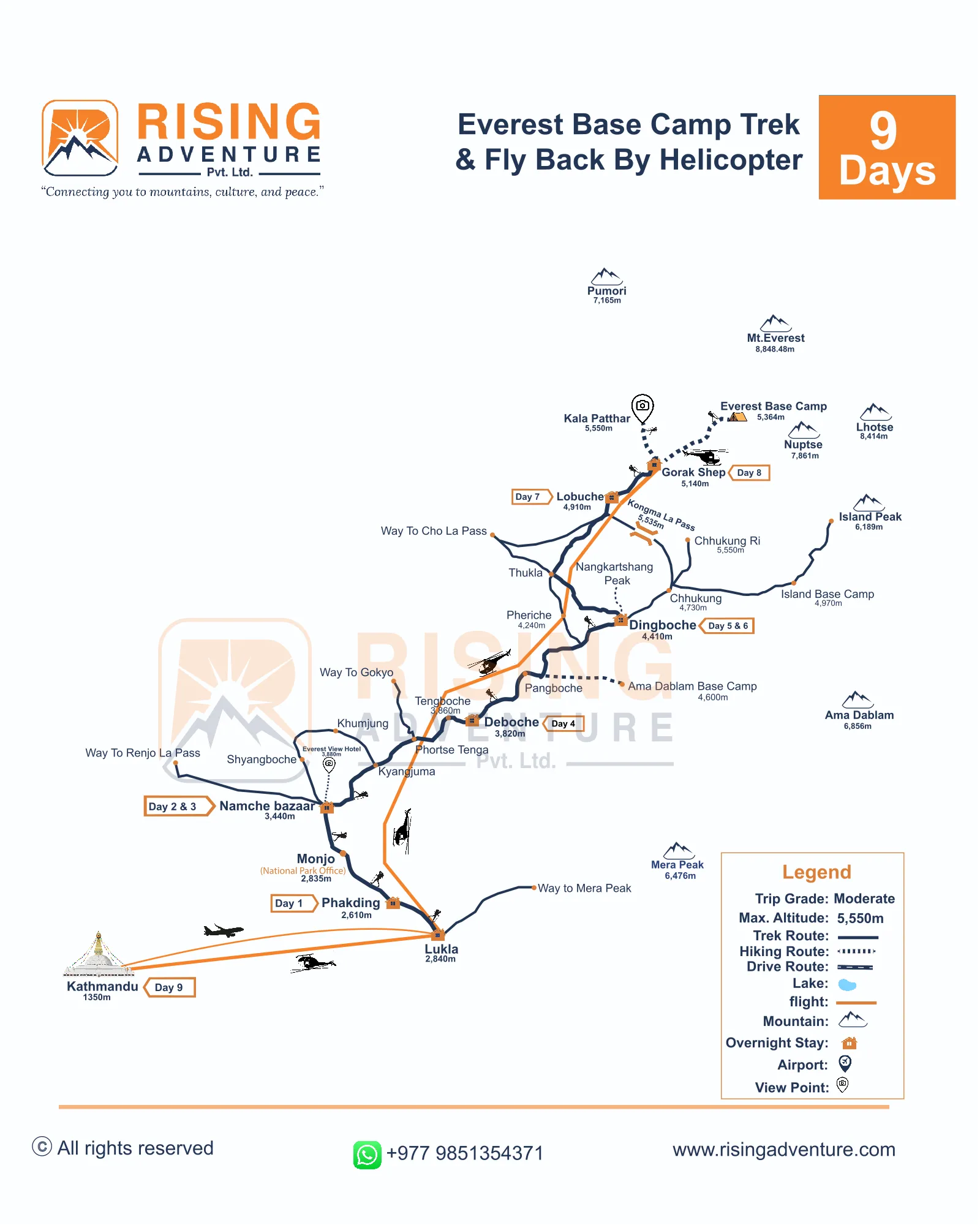
The path will go along the Dudh Koshi River, traversing through several Sherpa villages. We will walk inside the Sagarmatha National Park and visit several charming villages like Namche Bazaar, Tengboche, and Dingboche. En route, we will encounter several suspension bridges, monasteries, prayer flags, and spectacular Himalayan vistas.

We will then head to Lobuche and Gorak Shep before reaching the world’s renowned Everest Base Camp. The feeling of reaching the base of the highest point in the world will be out of this world. We can take as many pictures as we want and enjoy the moment to the fullest at the base camp.

After reaching the Everest base camp, we will go on a hike to one of the most legendary viewpoints in the Everest region, Kalapatthar. We will enjoy arguably the best sunrise view over the towering Mount Everest and the surrounding peaks.

Now begins the most special part of the journey. From Gorakshep, we will take a helicopter ride, offering the awe-inspiring views of the mountains and glaciers in the Khumbu region.

We will land in Kathmandu in a matter of moments, bringing your epic Everest Base Camp journey to a stylish conclusion.

Why choose Rising Adventure for the Everest Base Camp Heli Trek?

  • Serving in the Nepal tourism sector for 10+ years with a solid reputation
  • Always mindful of the safety of our customers and responsible tourism
  • Licensed guides who are good English speakers with vast local knowledge of the Khumbu region
  • Carefully designed itineraries by working with our expert travel consultants to match your preferences and conditions
  • Transparent pricing and availability of refunds (if it matches our terms and conditions)
  • Ethical treatment and fair wages, as well as insurance provided to our guides and porters
  • All the permits, food, accommodation, and other needs of the Everest Base Camp Trek with helicopter return are taken care of
  • Years of expertise in operating the EBC trek and helicopter return package
  • Several options for secure payments, including online, bank, and card transfers worldwide
  • Arrangement of the adventure for families, friends, newly formed groups, and even solo travelers
  • 24/7 support before and during your trek via WhatsApp, Viber, email, and other communication channels
Chat us on WhatsApp
+977 9851354371

Weather conditions, trail situation, and local factors may change the scheduled itinerary of the EBC heli return trek.

Short Itinerary & Altitudes
Starts From: Kathmandu
Ends At: Kathmandu

Everest Base Camp Trek and fly back by Helicopter Detailed Itinerary

Day 1

Arrival in Kathmandu

One of the Rising Adventure representatives will meet you at the Tribhuwan International Airport. The representative will welcome you in the traditional Nepali fashion with a Khada (traditional scarf) and then we head to our hotel. We will have a brief meeting later in the day. During our meeting, you will meet your guide for your Everest Base Camp trek with helicopter return.

Day 2

Scenic flight to Lukla

We will go on an early morning drive from Kathmandu to Ramechhap/Manthali. The drive will take around 4-5 hours. From Manthali, we will take a 20-minute scenic flight to Lukla. We will eat our breakfast in Lukla, where we will also find our porter for the trek. One porter will carry up to 20 kilograms of luggage. We will then begin our trekking towards Phakding, along the Dudh Koshi River. We will have an overnight stay at Phakding.

Day 3

Trek from Phakding to Namche Bazaar

Today we will be heading to the bustling town of Namche Bazaar. The route is along the Dudh Koshi River, with a number of suspension bridges on the way. We will reach the entrance of the Sagarmatha National Park, where we will carry out our permit check to trek in the Everest region. Our journey will proceed forward and we will eventually arrive at the beautiful town of Namche Bazaar, a town full of trekkers and friendly local Sherpas.

Day 4

Rest and Acclimatization Day at Namche Bazaar

This day at Namche Bazaar will be a rest day. This is the ideal time for us to adapt to the thin air, explore the lively town, and get to learn the lifestyle and culture of the local Sherpas. Today we can visit the major attractions of the town, such as the Sherpa Cultural Museum, Khumjung Monastery, and Hillary School. 

We will also go on a hike to Syangboche Airport and then to Everest View Hotel, where we will get incredible views of Mount Everest, Ama Dablam, Lhotse, and several other peaks.

Day 5

Trek from Namche Bazaar to Tengboche

We will move towards Tengboche today. The trek begins after we have our morning breakfast. The path will wind through a beautiful rhododendron forest before reaching Phungi Thenga. Along the way to Tengboche, we will encounter several chortens, stupas, prayer flags, and Buddhist signs. 

Upon reaching Tengboche, we will be greeted with amazing views of the Himalayan peaks, such as Mount Everest, Nuptse, Ama Dablam, and Lhotse. We will be visiting the Tengboche Monastery, the largest and the oldest monastery in the Khumbu region. If we are lucky enough, we will also get the chance to witness the Lamas performing a prayer ceremony in the evening.

Day 6

Trek from Tengboche to Dingboche

Today’s path follows through the alpine forest and a suspension bridge over the Imja Khola to reach Debuche. En route, we will see a stone-inscribed wall and also get an awe-inspiring view of Ama Dablam. We will then pass through Pangboche village and finally reach the village of Dingboche. At Dingboche, we will get beautiful views of Mount Lhotse, Island Peak, and Taboche.

Day 7

Rest and Acclimatization day at Dingboche

This will be our second day of acclimatization at Dingboche for adapting to the high altitude and preventing altitude sickness. Today, we will go on a hike to Nakarsang Peak and witness amazing views of Ama Dablam, Makalu, Island Peak, and Lhotse. For the rest of the day, we can explore the local teahouses and coffee shops or observe the grazing yaks in Dingboche.

Day 8

Trek from Dingboche to Lobuche

We will make a gentle ascent to Thukla. Further continuing our journey, we will reach stone memorials. These memorials are built to remember the climbers who lost their lives on Everest. We will learn about their stories and pay our tributes to the courageous souls. Then, we take a short hike to arrive at Lobuche. We will have our overnight stay in Lobuche.

Day 9

Trek from Lobuche to Gorak shep and hike to Everest Base Camp

We will have an early morning breakfast in Lobuche and head towards Gorak Shep, the last stop before the Everest Base Camp. Along the way to Gorak Shep, we will witness an amazing view of Mount Nuptse.

We will have our lunch at Gorak Shep, leave all our belongings at our teahouse, and make our climb towards Everest Base Camp. On our way, we will have amazing scenery of Khumbu Glacier and Khumbu Icefall.

We are rewarded with breathtaking scenes of Mt. Everest, Pumori, Khumbutse, Nuptse and other peaks as we get to the Everest Base Camp (5,364 m). We will be celebrating, taking outstanding photographs, and embracing our time at the foot of the tallest mountain in the world, Mount Everest. We will then travel back to Gorakshep, where we will have the overnight stay.

Day 10

Early morning hike to Kalapatthar and flyback to Kathmandu

We will begin our day with an early morning hike to the Kalapatthar (5,555 m), which is one of the most famous viewpoints of the entire Everest region. From the vantage point, we get to see the spectacular sunrise view over Mount Everest and other surrounding mountain peaks, including Nuptse and Lhotse.

Then we will retrace our steps back to Gorakshep and then have our helicopter ride that will take us back to Kathmandu. The helicopter ride will provide us with amazing aerial views of Mount Everest and other massive mountains as well as the picturesque villages and glaciers of the Everest region. We will arrive at Kathmandu Airport in the afternoon or early evening and then we will drive to our hotel.

Still Confused?
Just ask us. We’ll help you choose the right trek and plan everything smoothly.
Map

Private Trip

Equipment Lists for Everest Base Camp Trek and fly back by Helicopter

Everest Base Camp heli Trekking Gears

Below are the tentative lists of Everest Base Camp heli equipment.

Upper Body Layers
  • Outer Warmer Jacket
  • Base layer Jacket
  • Waterproof Rain Jacket
  • Down Jacket
  • Windproof jacket
  • Fleece-type Jacket
  • Trekking Shirt
  • Inner windproof Thermal gloves
  • Outer Gloves
Lower Body Layers
  • Inner body and leg Thermal
  • Rain Trousers
  • Windproof pants
  • Sports Underwear
Footwear & Accessories
  • Hiking Boots
  • Trekking Boots
  • Gaiters
  • Hiking Socks
  • Warm Thermal Socks
Head & Sun Protection
  • Sun Hat
  • Warm Beanie
  • Warm Scarf
  • Sunscreen
  • Sunglasses
Personal & Medical Kits
  • Medicine, if you are taking
  • First Aid Kit (Our guide keeps)
Travel Documents
  • Passport
  • Nepal Visa
  • Two passport-size photos
  • Travel Insurance
Miscellaneous
  • Trekking Bag
  • Duffel Bag (Rising Adventure provides)
  • Light Day Bag
  • Small Waist Money Purse
  • Sleeping Bag (optional)
  • Trekking Poles
  • Headlight
  • Water Bottle
  • Towel
  • Toilet Papers
  • Waterproof Bag Cover
  • Lock for Bags
  • Lip Gloss

Essential Information

Accommodations during the Everest Base Camp trek with Helicopter return

During the Everest Base Camp Trek with helicopter return, you will be staying in local teahouses/lodges. Most of the rooms will have twin beds, thin mattresses, pillows, and blankets. You will get rooms with attached bathrooms in the lower region, but you will mostly have shared bathrooms as you go into the higher regions.

Electricity for device charging, WiFi, and hot showers are available in most locations, but will come at an additional charge. Heaters won't be available in the bedrooms of most of the teahouses, and you will typically get warmth in the dining room, where there will be a heated stove. The dining hall is a great place to hang out and share stories with your friends and other travelers while having your meal.

Meals for the Everest Base Camp Heli Trek

The food for the EBC Heli Trek will be simple, hygienic, and nutritious. You will have local as well as international options to choose from for your meal. The most common dish for the trek will be the traditional Daal Bhaat Tarkari (rice, lentils, and veggies), which is tasty as well as energizing. 

The breakfast options include tea, coffee, hot lemon, hot chocolate, bread with butter/jam/honey, Tibetan bread/chapati, eggs, and pancakes.

For lunch and dinner, you can have Daal Bhat Tarkari with pickle and salads, noodles, fried rice, soup, momo (Tibetan dumplings), garlic soup, mushroom soup, spring rolls, pizza, sherpa stew, macaroni, and spaghetti.

You will be served 3-course meals (breakfast, lunch, and dinner) every day. You will have one drink for every meal. It is important to stay hydrated throughout the day on your trek to avoid altitude sickness. Avoiding alcohol will be a wise choice when you are in the high-altitude regions.

Best time to do the Everest Base Camp Trek with Helicopter return

The most suitable times to do the Everest Base Camp trek with a helicopter return are during spring (March to May) and autumn (late September to November). The trek can be done throughout the year, but it is still highly recommended to do it in these preferred seasons.

These seasons provide clear mountain scenery, stable weather, and warm temperatures. They also offer excellent conditions for a safe and scenic helicopter ride.

Here’s a breakdown of what each season has to offer for the Everest Base Camp heli trek.

Spring (March to May)

Spring is considered to be one of the best seasons for trekking in the Everest region. The season brings stunning natural beauty with rhododendron and wildflower blooms. The weather is very stable, and the mountain visibility is usually very clear in this season. The trekking trail is very suitable and comes alive with rich greenery in the lower regions. The average daytime temperature ranges from 10°C to 20°C, while the night temperature can reach up to -15°C in higher regions. This season is perfect for trekkers who are nature and photography lovers.

Summer/Monsoon (June to August)

This season is not much preferable for the trek due to unpredictable weather conditions. There is frequent rainfall in this season (especially in July and August). The trail is slippery and muddy, making the trek very challenging. The average daytime temperature during this season is about 22°C, while it can reach up to -5°C during nighttime at higher elevations. You can expect flight delays in Lukla and helicopter ride delays due to unfavorable weather conditions. So, we recommend that you have a few extra days for your trek to adjust to these conditions. 

If you want a peaceful trail and want to see waterfalls, then trekking during this season might be a good option for you. 

Autumn (late September to November)

Autumn is the most preferred season to trek in the Everest region. The skies are very clear after the monsoon rain, and the mountain scenery is at its best. The average daytime temperature is between 15°C and 22°C, while the nighttime temperature reaches as low as -15°C in the higher altitude regions. This is one of the busiest seasons, so early booking can be considered a wise choice. Nepal also celebrates Dashain and Tihar during this season (late September or October). So travelers can get the opportunity to celebrate Nepal’s main festival if they trek around this time. 

This season is perfect for trekkers who are photography lovers, experience the culture and main festivals of Nepalese people, and want to get the best Himalayan scenery.

Winter (December to February)

Most trekkers do not prefer winter for traveling in the Everest region. This season presents cold weather with daytime temperatures ranging from -5°C to 10°C. The nighttime gets even colder, with the temperature reaching up to -20°C in higher regions above 4000 m. You can still get great mountain views, but sometimes the clouds can block the entire visibility. People can opt for trekking during this season if they are accustomed to cold weather conditions and want a more peaceful trail.

Everest Base Camp Heli trek difficulty

The difficulty of this trek can be categorized as moderate to challenging. It can be challenging for beginners due to trekking at high altitude for about 10 or more days. There is no technical climbing involved during this trek. However, you need to walk 5-7 hours on a regular basis.

Along the route, you will have to traverse through steady ascents, rocky paths, and some steep areas. You will also trek in high-altitude areas above 5000 meters, such as the Everest Base Camp and Kalapatthar viewpoint. Walking at a steady pace, staying hydrated, and proper acclimatization become very crucial when hiking in those high-altitude areas to avoid altitude sickness. 

Your return journey will be with a helicopter ride, making it an easier trek compared to the classic Everest Base Camp trek. 

Permits Required for the Trek

For the EBC trek with helicopter return, you will need to have two major permits. They are:

i) Sagarmatha National Park Permit

ii) Khumbu Pasang Lhamu Rural Municipality Permit

These permits are essential for trekking in the protected areas of the Khumbu region. You can obtain these permits in Kathmandu or in Monjo at the entrance of the Sagarmatha National Park. Rising Adventure will issue and collect these permits on your behalf so that your trek in the Everest region is smooth and hassle-free. 

Customers Reviews

A Life-Changing Experience with Rising Adventure!

I recently completed the Everest Base Camp Trek with Rising Adventure, and it was one of the most incredible journeys of my life. From the very first message, their communication was prompt, clear, and professional....

S
Sara - United Kingdom
May 29, 2025
Flawless Trek to Everest Base Camp – Highly Recommend!

My Everest Base Camp trek with Rising Adventure was an unforgettable experience from start to finish. As a solo female traveler, I was a bit nervous at first, but the team made me feel completely...

E
Eleanor - United Kingdom
May 23, 2025
Chandan Thapa
Chandan Thapa
Founder & Team Leader
Silu Pandey
Silu Pandey
Sales and Marketing
We're Here to Help

Meet Our Local Experts

With years of experience and deep cultural knowledge, our local guides make your trek safe, meaningful, and unforgettable.
Need Help? Call Us+977 9851354371