
Rising Adventure takes care of you on every step of the journey of the Everest Three Passes Trek. We manage permits, flights, and pre-trek arrangements to ensure a smooth start. You will be provided with comfortable teahouses, healthy food, and a high-altitude trekking experience. Our experienced and friendly guides and porters, along with their local knowledge of the Khumbu region, will make sure your trip to the challenging three high passes is safe, well-organized, and unforgettable.
Everest Three Passes Trek
Trip Facts
Duration
19 Days
Trip Grade
Level 3 - Intermediate
Country
Nepal
Maximum Altitude
5545 m
Starts
Kathmandu
Ends
Kathmandu
Group Size
1-20
Activities
Trekking
Best Time
March-May and Sept-Nov
The Everest Three Passes Trek is a difficult high-altitude trek in the Everest region that passes through Renjo La, Cho La, and Kongma La. It connects the Khumbu Valley and Gokyo Valley, which brings trekkers to the Everest Base Camp, Kala Patthar, and Gokyo Lakes, and goes through the Sherpa villages, monasteries, glaciers, and Alpine scenery.
Everest High Passes Trek Nepal itinerary is designed to be completed in approximately 19 days, including arrival to departure in Nepal, aiming at people from the young to the 60s. The 3 High Passes present spectacular Himalayan scenery and a blend of cultural and natural wonders.
Highlights of Everest Three Passes Trek
- Enjoy the scenic flight from Kathmandu to Lukla and back.
- Experience the lives and culture of authentic mountain people (Sherpa people).
- Visit monasteries, including the biggest monasteries in the khumbu region- Tengboche Monastery.
- Pass through the thrilling and famous Everest Three Passes (Kongmo La, Cho La, and Renjo La).
- Reach the Everest Base Camp.
- Visit Gokyo Ri and witness magnificent views of world-renowned mountains such as Everest, Lhotse, Makalu, and Cho Oyu.
- View the stunning beauty of the world’s highest freshwater lake water system- Gokyo Lake (Dudh Pokhari).
- Walk on the highest glacier on Earth- Khumbu Glacier.
- Gaze at the stunning panoramic views of Mount Everest from Kala Patthar.
You'll Explore It
Short Itinerary & Altitudes
Day 1:
Arrival in Kathmandu
Altitude: 1,350m
Day 2:
Scenic Flight from Kathmandu to Lukla and trek to Phakding
Altitude: 2,652m
Day 3:
Trek from Phakding to Namche Bazaar
Altitude: 3,440m
Day 4:
Rest day at Namche Bazaar for Acclimatization and hike to Everest View Hotel
Altitude: 3,440m
Day 5:
Trek from Namche Bazaar to Tengboche
Altitude: 3,870m
Day 6:
Trek from Tengboche to Dingboche
Altitude: 4,360m
Day 7:
Trek from Dingboche to Chhukung
Altitude: 4,730m
Day 8:
Rest Day at Chhukung for Acclimatization
Altitude: 4,730m
Day 9:
Trek from Chhukung to Lobuche via Kongma La Pass
Altitude: 4,920m
Day 10:
Trek from Lobuche to Gorak Shep and Hike to Everest Base Camp
Altitude: 5,140m
Day 11:
Trek from Gorak Shep to Kalapatthar and then to Dzongla
Altitude: 4,830m
Day 12:
Trek from Dzongla to Thagnak via Cho La Pass
Altitude: 4,700m
Day 13:
Trek from Thagnak to Gokyo
Altitude: 4,750m
Day 14:
Rest day at Gokyo for acclimatization and hike to Gokyo Ri
Altitude: 4,750m
Day 15:
Trek from Gokyo to Marlung via Renjo La Pass
Altitude: 4,210m
Day 16:
Trek from Marlung to Namche Bazaar
Altitude: 3,440m
Day 17:
Trek from Namche Bazaar to Lukla
Altitude: 2,800m
Day 18:
Flight from Lukla to Kathmandu
Altitude: 1,350m
Day 19:
Final Departure
Everest Three Passes Trek Detailed Itinerary
Day 1
Arrival in Kathmandu
Our representative will welcome you at the Tribhuwan International Airport upon your arrival and transfer you to the hotel. After you take a rest for a while, we will have our discussion about the Everest Three Passes trek along with our experienced guide. You will stay overnight in Kathmandu.
Altitude: 1,350m (4,429ft)
Accommodation: 3 Star Hotel
Mode of Transportation: Private Car
Day 2
Scenic Flight from Kathmandu to Lukla and trek to Phakding
Early in the morning, you will have right around 35 minutes flight from Kathmandu to Lukla, at around 2800 m in the Khumbu area of Nepal. While in the Airplane we can have extraordinary perspectives on the mountains and stream valleys. After the landing in Lukla, our guide will present with the porter if the trip package includes. From your trek sets out onto Phakding at just about 2652 m.
Altitude: 2,652m (8,700ft)
Duration: 35 minutes & 3 hours
Meals: Breakfast, Lunch, Dinner, & Seasonal Fruits
Accommodation: Tea House
Mode of Transportation: Private car & Aeroplane
Day 3
Trek from Phakding to Namche Bazaar
On this day, you will proceed with your trek for nearly 7 hours until you won't arrive at the Namche bazaar, which is taken as the Gateway to Everest. While trekking, you will go on through stunning views, for example, blue pine woods, firs, junipers, and other delightful views.
Altitude: 3,440m (11,286ft)
Duration: 6-7 hours
Meals: Breakfast, Lunch, Dinner, & Seasonal Fruit
Accommodation: Tea House
Day 4
Rest day at Namche Bazaar for Acclimatization and hike to Everest View Hotel
Namche Bazaar, also known as the European city of Nepal, is the biggest settlement in the Khumbu region. Today, you will rest at Namche Bazaar, and you might also explore the major attractions, including the Sherpa Museum, Hillary School, Khumjung Monastery, and Syangboche Airport. You will make about a 1.5-hour hike to Everest View Hotel, one of the world’s highest hotels, and enjoy ourselves with stunning views of the Himalayas.
Altitude: 3,440m (11,286ft)
Meals: Breakfast, Lunch, Dinner, & Seasonal Fruits
Accommodation: Tea House
Day 5
Trek from Namche Bazaar to Tengboche
Today, we will be making 6-7 hour trek towards Tengboche. On the way, we will pass through pine forests and cross bridges across the Dudh Koshi River and might also spot wildlife like musk deer, Himalayan Thar, and colorful pheasants. After trekking for a while, we will reach a small settlement known as Phungi Thanga and then Tengboche. During the stay at Tengboche, we can experience the religious ceremony by the monks at Tengboche Monastery, the largest monastery in the Khumbu region.
Note: During peak seasons, our overnight stay will be in the guesthouse of Deboche, which takes around a 30-minute walk downhill from Tengboche.
Altitude: 3,870m (12,696ft)
Duration: 6-7 hours
Meals: Breakfast, Lunch, Dinner, & Seasonal Fruits
Accommodation: Tea House
Day 6
Trek from Tengboche to Dingboche
Today’s route will take us through forests while crossing the suspension bridge on the Imja River, witnessing endangered species such as musk deer and Daphne on the way, and leading to Pangboche. We will be treated to an amazing view of Ama Dablam from Pangboche. We will then walk further to the mountainous terrain of Somare and then finally reach Dingboche. We can get stunning views of the mountain titans such as Ama Dablam, Island Peak, and Mount Lhotse from Dingboche, where we will have an overnight stay.
Altitude: 4,360m (14,304ft)
Duration: 6-7 hours
Meals: Breakfast, Lunch, Dinner, & Seasonal Fruits
Accommodation: Tea House
Day 7
Trek from Dingboche to Chhukung
Today, we hike to Bibre at first as the yak herdsman's place, and then to Chhukung. The people residing in this region are mostly Sherpas. We might also see glaciers and snow-capped mountains from Chhukung. We can enjoy the mesmerizing view of the surrounding peaks for the rest of the day before the overnight stay.
Altitude: 4,730m (15,518ft)
Duration: 3-4 hours
Meals: Breakfast, Lunch, Dinner, & Seasonal Fruits
Accommodation: Tea House
Day 8
Rest Day at Chhukung for Acclimatization
We have scheduled a rest day at Chhukung to acclimatize our bodies to the high altitude. We can gaze at stunning mountain views near the area, including Island Peak, Mount Makalu, and Baruntse. We also have the option to hike to the Chhukung Ri, which is the peak over the Chhukung Village or Island Peak Base Camp today.
Altitude: 4,730m (15,518ft)
Meals: Breakfast, Lunch, Dinner, & Seasonal Fruits
Accommodation: Tea House
Day 9
Trek from Chhukung to Lobuche via Kongma La Pass
Kongma La Pass is the first and highest pass of the Everest 3 Passes. Today’s destination will be Lobuche, which has two possible routes to reach there. We have the option to climb through the slope from Chhukung to the Nuptse glacier or just retrace our steps back to Bibre and ascend to Niyang Khola.
We can see cairns, marks of the pass, and Buddhist prayer flags at the top of Kongma La Pass. The descent from the top will be really difficult. After the climb to the far-side moraine and then north along the Khumbu Glacier, we will be reaching Lobuche, our destination for today.
Altitude: 4,920m (16,141ft)
Duration: 6-7 hours
Meals: Breakfast, Lunch, Dinner, & Seasonal Fruits
Accommodation: Tea House
Day 10
Trek from Lobuche to Gorak Shep and Hike to Everest Base Camp
Our journey of the Everest Three High Passes will continue from Lobuche through the Khumbu Glacier. First, we will take an ascent to Thangma Riju, and after climbing the steep trail, we will reach the top of Changri Glacier and Gorak Shep. Today’s journey will continue to Everest Base Camp, where we will be mesmerized by the beauty of the Himalayan vistas of the Nuptse, Khumbuste, and Pumori mountains. We will return to Gorak Shep and stay overnight there.
Altitude: 5,140m (16,863ft)
Duration: 7-8 hours
Meals: Breakfast, Lunch, Dinner, & Seasonal Fruits
Accommodation: Tea House
Day 11
Trek from Gorak Shep to Kalapatthar and then to Dzongla
We will begin the hike early in the morning to Kalapatthar to witness the first ray of light strike over the mighty Mount Everest. Today’s trek will be difficult, but the sight of a 360-degree view of Mount Everest, Lhotse, Nuptse, Ama Dablam, Lobuche Peak, and others will make it worthwhile. We will then return to Gorak Shep and have breakfast there. The trek will continue, taking us back to Lobuche and then to Dzongla through a scenic trail.
Altitude: 4,830m (15,846ft)
Duration: 7-8 hours
Meals: Breakfast, Lunch, Dinner, & Seasonal Fruits
Accommodation: Tea House
Day 12
Trek from Dzongla to Thagnak via Cho La Pass
The route from Dzongla to Thagnak via Cho La Pass is going to be a challenging one. We will have an early start from Dzongla, passing through spur woodlands to Cho La Pass. We will witness the stunning beauty of Cho La Lake, Lobuche East and West, and Mount Cholatse from the pass. We will then make our way down to Thagnak for the overnight stay.
Altitude: 4,700m (15,419ft)
Duration: 6-7 hours
Meals: Breakfast, Lunch, Dinner, & Seasonal Fruits
Accommodation: Tea House
Day 13
Trek from Thagnak to Gokyo
Today’s trek of the Everest Three Passes will go through the longest glacier in Nepal, Ngozumpa Glacier, to Gokyo. As we get closer to Gokyo, the open path gets more visible, and we will witness the stunning series of turquoise lakes of Gokyo Valley. Gokyo is one of the best spots of this entire trip, offering views of the majestic glacial lakes and the mountain terrains behind it.
Altitude: 4,750m (15,583ft)
Duration: 6-7 hours
Meals: Breakfast, Lunch, Dinner, & Seasonal Fruits
Accommodation: Tea House
Day 14
Rest day at Gokyo for acclimatization and hike to Gokyo Ri
This is a final rest day at Gokyo for acclimatization. On this day, we will be going on an early morning hike to Gokyo Ri, which offers the gorgeous views of Thonak Tsho Lake and the Ngozumba Tsho Lake. From here, we can also get close-up views of the legendary peaks, such as Mount Everest, Lhotse, Makalu, and Cho-Oyu. Then we will head back to Gokyo Valley.
Altitude: 4,750m (15,583ft)
Meals: Breakfast, Lunch, Dinner, & Seasonal Fruits
Accommodation: Tea House
Day 15
Trek from Gokyo to Marlung via Renjo La Pass
To reach Marlung, we need to go through Renjo La Pass, the final pass of the Everest High Passes trek. After about 3 hours of hiking, majestic views of Everest, Lhotse, Cholatse, and Taboche can be observed. We will then descend to Lumde, filled with massive stones. We will finally reach the Marlung village, inhabited by Sherpas, where we can soak in the beauty of Relama Tsho and Renjo Lake.
Altitude: 4,210m (13,812ft)
Duration: 7-8 hours
Meals: Breakfast, Lunch, Dinner, & Seasonal Fruits
Accommodation: Tea House
Day 16
Trek from Marlung to Namche Bazaar
Today’s journey will be a descent to Taranga, passing through the Bhote Koshi River. We will also go through the rhododendron forest along the way and further trek along the descending path by crossing two bridges to reach Thame.
From Thame, the famous Gompa is visible to the west on a hillside. Again, we will be walking on a descending path, traversing a few villages to arrive at Namche Bazaar. When we reach Namche Bazaar, our journey will feel like it has come a full circle, just like our lives.
Altitude: 3,440m (11,286ft)
Duration: 6-7 hours
Meals: Breakfast, Lunch, Dinner, & Seasonal Fruits
Accommodation: Tea House
Day 17
Trek from Namche Bazaar to Lukla
We will now be returning to Lukla following the same route as before. We will be starting with a descending path crossing several suspension bridges over the Dudh Koshi River. Then, the route will level out, where we can enjoy the beauty of nature with rhododendron and pine forests with stunning views of the peaks from a distance.
Finally, we will arrive at Lukla, where we are going to spend the night wotj reminiscing about all the unforgettable memories that we made on the entire journey of the Everest Three Passes.
Altitude: 2,800m (9,186ft)
Duration: 6-7 hours
Meals: Breakfast, Lunch, Dinner, & Seasonal Fruit
Accommodation: Tea House
Day 18
Flight from Lukla to Kathmandu
We will fly early in the morning to Kathmandu, enjoying the scenic Himalayan vistas along the flight. We will then get back to our hotel and rest again after the rewarding journey has come to an end.
Altitude: 1,350m (4,429ft)
Duration: 35 minutes
Meals: Breakfast & Farewell Dinner
Accommodation: 3 Star Hotel
Mode of Transportation: Plane & Private Car
Day 19
Final Departure
Our representative will leave at the International Airport three hours before your flight schedule.
Meals: Breakfast
Mode of Transportation: Private Car
Need Help Planning?
Let our local experts plan your perfect journey across Nepal, Tibet, and Bhutan.
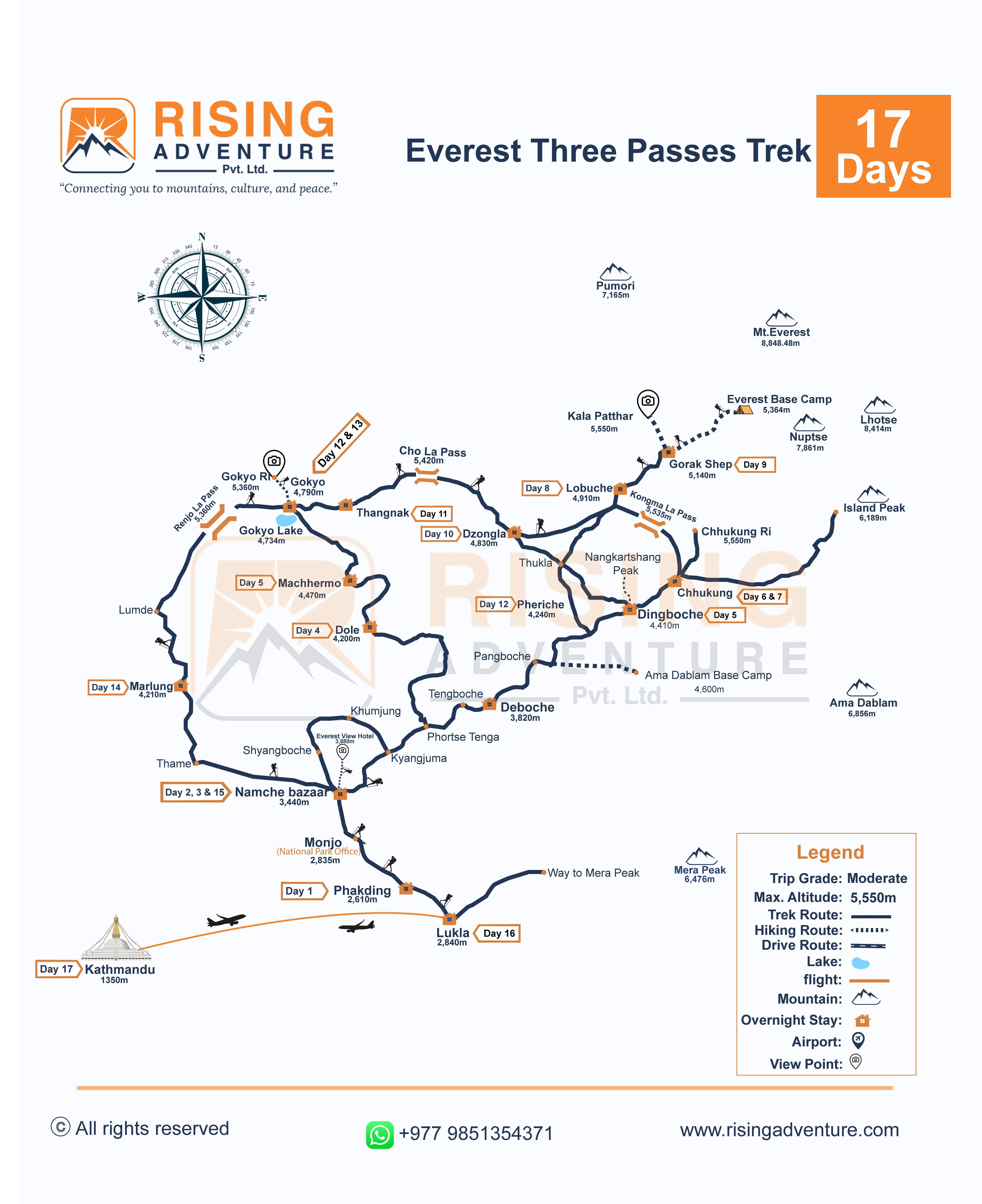
Map
Altitude Chart
Cost Details
What’s Included
- International and domestic airport pick-up and drop-off service
- Two nights' accommodation in a 3-star hotel in Kathmandu, including breakfast (Hotel Vistara or Similar)
- Domestic Flight tickets from Kathmandu to Lukla to Kathmandu (June to September & December to March)
- Domestic Flight tickets from Ramechhap to Lukla to Ramechhap (April, May, October, & November)
- Only 15 kg of luggage, including a handbag, is allowed to be carried on the domestic flight
- Sagarmatha National Park entry permit
- Khumbu Pasang Lhamu Rural Municipality permit
- Experienced, licensed, English-speaking local trekking guide from your warm welcome on arrival to your final departure
- Friendly and reliable porter (one porter shared between two trekkers, carrying up to 20 kg), who will meet you in Lukla
- Three meals daily during the trek (breakfast, lunch, and dinner), with one main course per meal
- Seasonal fruit after/with dinner during the trek
- 16 nights teahouse accommodation during the trek
- Duffle bag for the trekking gear packing (Must be returned after the trip)
- Sleeping bag and down jacket if needed (return after the trek)
- Sport T-shirt/Cap of Rising Adventure as a souvenir
- First Aid Kit (a light kit carried by a guide)
- Travel & Rescue arrangements
- Trek Completion Certificate with your photo
- Water purifying tablet, if needed
- Free coordination in emergency cases
- All the government taxes and service charges
- Farewell dinner at one of the typical Nepalese restaurants with a traditional dance
Note: Our guides and porters are fully insured.
What’s Excluded
- Nepal arrival visa fee
- Travel Insurance
- Entrance fees at the monument places in Kathmandu
- Alcoholic and nonalcoholic drinks
- All your personal expenses
- Hot shower, Battery charge, and heater during the trekking
- Tips for the guide and porter
- Other expenses that are not mentioned in the trip "Cost Includes"
Private Trip
Add-Ons & Options
You may add the following options too;
Helicopter from Kathmandu to Lukla
US$400 / person
During the busiest season, hiring the helicopter is the best option to reach Lukla early and enjoy the views.
Equipment Lists for Everest Three Passes Trek
Typically, no technical equipment is needed for the Everest High Passes Trek. But you should have some technical clothing from head to toe. You can buy or hire such clothes to complete the packing list before your trek begins.
The clothes for the trek to Everest High Passes will depend on the season. If it is winter, you must pack warmer clothes. If you are trekking in the monsoon, the packing should include rainproof clothes. If it is summer, you can have lighter clothes.
Upper Body Layers
- Outer Warmer Jacket
- Base layer Jacket
- Waterproof Rain Jacket
- Down Jacket
- Windproof jacket
- Fleece-type Jacke
- Trekking Shirt
- Inner windproof Thermal gloves
- Outer Gloves
Lower Body Layers
- Inner body and leg Thermal
- Rain Trousers
- Windproof pants
- Sports Underwear
Footwear & Accessories
- Hiking Boots
- Trekking Boots
- Gaiters
- Hiking Socks
- Warm Thermal Socks
Head & Sun Protection
- Sun Hat
- Warm Beanie
- Warm Scarf
- Sunscreen
- Sunglasses
Personal & Medical Kits
- Medicine, if you are taking
- First Aid Kit (Our guide keeps)
Travel Documents
- Passport
- Nepal Visa
- Two passport-size photos
- Travel Insurance
Miscellaneous
- Trekking Bag
- Duffel Bag (Rising Adventure provides)
- Light Day Bag
- Small Waist Money Purse
- Sleeping Bag (optional)
- Trekking Poles
- Headlight
- Water Bottle
- Towel
- Toilet Papers
- Waterproof Bag Cover
- Lock for Bags
- Lip Gloss
Essential Information
Accommodation
During your time in Kathmandu, you will be staying in a 3-star hotel. In the case of the Everest Three High Passes Trek in the Everest region, the accommodation is offered in traditional teahouses operated by the local Sherpa families. These lodges are simple yet appealing with basic beds and blankets, mostly with twin-sharing rooms. At the lower altitudes, such as Namche Bazaar, the facilities are relatively more comfortable, and there are options of hot showers, Wi-Fi, and charging devices, but the higher you get towards the passes, the fewer facilities are provided. The facilities are simple, but the hospitable reception and mountain feel will make sure your trip is unforgettable.
Food
We will provide you with breakfast and dinner as you spend your time in Kathmandu. During the trek, the breakfast and dinner will be based on the lodges you are staying in at the time. The meals are served at the teahouse dining areas, and they include Nepali, Tibetan, Chinese, and basic continental dishes. The safest and most feasible choice is the traditional Dal Bhat, which is made fresh and available in most lodges. Other typical options are noodles, fried rice, soups, pasta, momos, eggs, and porridge.
Best Time to Travel
The best seasons to do the Everest Three Passes Trek are spring and autumn, when the weather is the most stable and visibility is at its best. The period of spring (March-May) is characterized by the clear skies, the moderate temperatures, and the rhododendrons blooming to light up the trail.
The autumn season (late September-November) is characterized by cool weather, dry trails and some of the best mountain scenery after the end of the rainy season. Both seasons offer favorable conditions for crossing the high passes.
Conversely, monsoon season is characterized by heavy rainfall and disruptions in flights, whereas winter is usually characterized by extreme cold and snow. Trekking during spring or autumn is highly recommended to have the best experience.
Frequently Asked Questions
General Info
What is the Everest Three Passes Trek about?
It forms a complete loop within the Everest region that takes you through three high passes (Kongma La Pass, Cho La Pass and Renjo La Pass), the Everest Base Camp, and numerous viewpoints, including Kalapatthar. Therefore, providing you an experience that blends with remote valleys, Sherpa culture, Himalayan vistas, and iconic viewpoints.
How long does the Three Passes trek take to complete?
The entire trip typically lasts around 17-20 days, including your arrival and departure days in Nepal. It is sufficient to cover the entire trek while adapting to the altitude. Rising Adventure has a structured 19-day schedule with sufficient rest days that will help you to acclimatize to the high altitude.
How difficult is the Everest High Pass trek?
It is regarded as a challenging trek, as the routes have very high points (above 5000 m), the days of climbing are long and the terrain can be hard. Thus, having good physical health and preparation is essential.
When is the best time to climb the Three Passes Trek?
Spring (March-May) and autumn (late September-November) are the most appropriate seasons to climb since the weather is stable, the skies are clear, and the paths are easier to walk.
Do I need a guide for this trek?
Yes, you can walk up the route alone, though a guide is favored by many to give guidance on the route and assistance in crossing the high passes. At Rising Adventure, we have guides with 10+ years of experience in climbing, so feel free to ask any questions or problems during the entire trek. A porter also comes in handy with regard to carrying your equipment.
What is the state of food, water, charging and ATMs in the Everest High Passes Trek?
The lodges serve meals, and water can be purchased or purified on the way. It is necessary to carry cash because the ATMs are only present in the lower villages. The high areas may not have stable internet connections or charging points.
What can I do to prevent altitude sickness while climbing the Everest Three Passes?
Climb with a steady pace, have rest days for acclimatization, drink lots of water, avoid consumption of alcohol, and be aware of your body’s condition. Warm clothes and good equipment also help you stay warm in the cold.
Can the duration of the Everest 3 High Passes Trek be adjusted?
Yes, itineraries can always be shortened or extended as per your pace, interests, and the amount of time you wish to spend at certain places. At Rising Adventure, you can tell us what changes you would like to have and we will tailor it to your needs. Additional costs may be imposed depending on the changes you want for the trek.
Do I need a visa to travel to Nepal?
Yes, you need to have a visa to travel to Nepal. You can get the on-arrival visa at the Tribhuwan International Airport. You can also apply for the visa at the Nepal Embassy.
Is it possible to rent trekking equipment in Kathmandu?
Yes. There are numerous rental shops in Thamel, Kathmandu, where you can rent down jackets, sleeping bags, trekking poles and crampons in case you need them. We at Rising Adventure will help you get the best deals for renting the equipment near the Thamel area.
Can first-time trekkers complete the trek?
The trek is not beginner-friendly. However, it can be done by beginners provided they are trained and are in great shape. They are advised to take several months of training before the trek, and they may seek the services of a guide for proper acclimatization and route management as a safe measure.
Is there any internet connection during the High Passes Trek?
The lower region of the trek has internet access in most of the villages. However, they are less reliable at higher altitudes. There are lodges that sell wifi cards or offer paid usage. Slow or inconsistent connections should be anticipated by you in the remote parts.
What are the major risks on the trek?
The primary risk factors include altitude sickness, dehydration and cold weather, slippery paths, exhaustion, and change of weather. They can be prevented by preparing well, maintaining steady pacing, and timely monitoring of your health.
Do single trekkers find the trail safe?
The path is mostly safe and well-marked, and numerous trekkers go alone with each season. Nonetheless, solo trekking involves lots of good judgment, knowledge of weather conditions, and proper acclimatization. Travelling with a guide or in a group enhances security in some of the isolated areas, such as the high passes.
What do I do to avoid altitude sickness?
A slow and steady ascent plan is recommended to avoid altitude sickness, along with rest days for acclimatization. Take lots of water during the day and avoid alcohol and smoking. Eat healthy food and pay attention to your body. When you experience headaches, nausea, dizziness and breathlessness, then make it known to your guide and take rest. The best treatment is to go down to a lower altitude.
What type of accommodation does the Everest Three Passes Trek offer?
There are teahouses and mountain lodges as the primary form of accommodation along the trail. The rooms are typically twin sharing with basic beds and blankets. Toilets are commonly shared, which may be either Western or squat style. Many of the places offer hot showers, wifi, and charging options at an additional fee. Comfort levels get more basic with an increase in altitude.
What should I do to physically prepare for the Everest 3 Passes trek?
Activities like hiking, jogging, climbing stairs, and long walks with a backpack are best to build endurance. Leg and core strength training will assist you in stabilizing on steep routes. Regular training will help to make the trek even more comfortable, and you will feel more confident.
What Our Clients Say
Best trek and best company
The trip was wonderful. The price great for the quality of trip with great views. I will come again for ABC trek in 2026 and meet Mr Thapa again.
M
Mary - Peru
May 17, 2025Loved the personalized High Passes Trek
What an amazing experience this was. Truly the experience of a lifetime. We set up a private tour which really let us customize. What I most appreciated, though, was their willingness to work with us...
S
Sandy - Poland
September 22, 2023

We're Here to Help 24/7
Meet Your Local Experts
Creating unforgettable journeys across Nepal, Tibet, and Bhutan.
At Rising Adventure, we believe in connecting you to mountains, culture, and peace. As your trusted local travel partner, we create safe, authentic, and unforgettable trekking, climbing, and tour experiences across Nepal, Tibet, and Bhutan. With experienced local experts and personalised service, we're with you every step of your journey, from your first enquiry to your final departure, ensuring a smooth, memorable, and truly unforgettable experience of a lifetime.