Permits and Requirements
The Island Peak Climbing Permit can be taken from the Nepal Mountaineering Association (NMA). NMA has designed mountaineering permit costs based on the season.
| Season |
Cost ($) |
| Spring |
250 |
| Autumn |
125 |
| Summer (Monsoon) |
70 |
| Winter |
70 |
As shown above, the Island peak climbing permit cost is relatively higher in the spring season as compared to other seasons. The spring is the peak season for summiting Imja Tse so, you can expect a lot of mountaineers during this period.
Likewise, autumn is another favorable season for mountaineering. Temperature and weather condition is favorable in this season as well. But, climbers seem fewer compared to the spring season.
Winter and Monsoon seasons are listed under the off-season category for peak climbing in Nepal. So, fewer climbers can be expected in these seasons.
Now, it is clear why NMA is charging the variant permit cost.
Sagarmatha National Park Entry permits
You might be wondering if paying only the NMA cost is enough but you will also have to pay the Sagarmatha National Park entry permit. Permit fee differs for SAARC nationals from other foreign nationals.
The permit fee for SAARC nations is 1500 Nepalese rupees while for foreign nations, it is 3000 Nepalese rupees.
Along with the Island peak climbing permit cost, you need to deposit USD 500 as a garbage deposit. But it is refundable money. You can get back this cash after returning from the peak summit.
Local Area Permit
In order to climb the Island peak, a local permit is also required as you are going through various local municipalities. If you travel with us, we make the permit ready before your journey commences. You can also get this local area permit in Lukla. The cost to pass around the municipality is around USD 20.
Travel Insurance
Travel Insurance is mandatory and of utmost necessity. If you want to climb Imja Tse with us you should definitely have one. The insurance should cover accidents, ambulance, and rescue with a helicopter if required.
To make you clear, Rising Adventure does not sell any travel insurance policy. Please, buy your travel insurance with one of the best and most reliable companies.
Island peak Accommodation
We provide two-night hotels in Kathmandu. One day is for your arrival and the next one is before your departure after coming back from trekking.
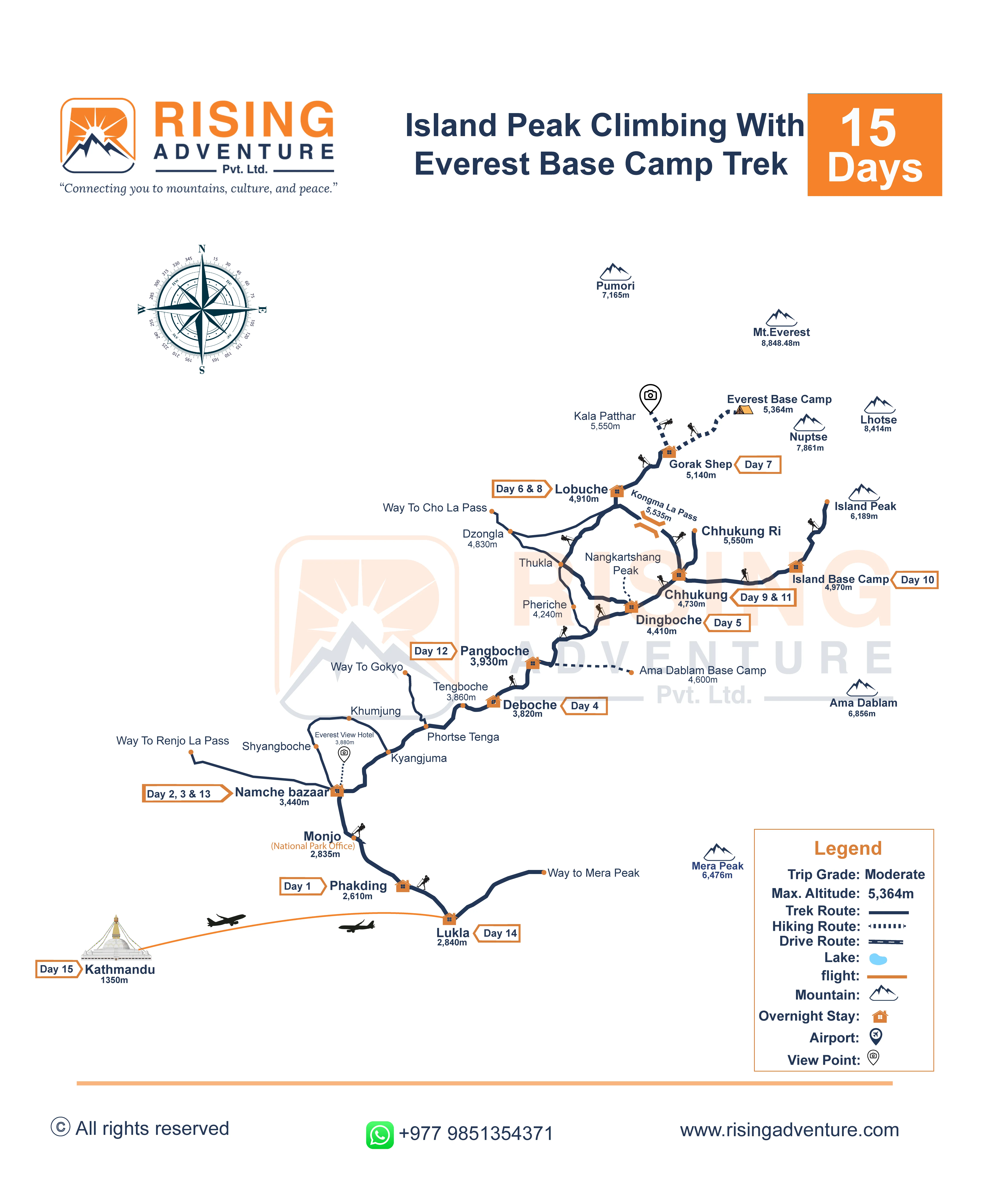
While talking about Island peak climbing with Everest base camp trek accommodation, the tea houses are used for getting rest and for acclimatization. It is a normal hotel in the Himalayan region of Nepal.
You can get everything in these teahouses from private bedrooms, attached bathrooms, Wifi, charging as well as hot water and a shower. You can also find verities of food and local cuisines in the teahouses at lower altitudes.
On the other hand, you can expect a teahouse with basic facilities at a higher elevation. Everest base camp trek teahouse provides a shared room with a shared traditional toilet in high-altitude places. You may get limited seasonal foods only. And the most important thing is you need to pay a little amount for Wi-Fi and mobile charging. For showering with hot water, you will be charged.
For three days of camping, we also provide three times meals, a sleeping tent, a dining tent, and a toilet tent. All of them are included in our package. We also provide you with a sleeping bag and a down jacket if necessary.
Best time to climb Island peak
The best time to summit Island would be in the spring season of March April and May. The Spring season is the clearer season. The temperature is also favorable with an average ranging from 20-25 degrees below 3500 meters. Above 3500 meters you can expect temperatures to drop below -15 degrees Celsius.
Though it is rainfall in this season, it is not wet as in the rainy season.
Another best season can be in autumn which is also a peak time to climb Imja Tse. The average temperature of elevation over 4000m is 15 degrees Celsius and could be high up to 20 degrees Celsius.
At night time, it can go a minimum of 0 -10 degrees Celsius. In September, you can expect some rainfall as it is the first month after the rainy season but it is not that severe.
Winter and monsoon seasons are off-season. In the winter season climbing is difficult because of the continuous heavy snowfall. The temperatures are freezing. The Summit of Island Peak can be windy which may create a very hard situation for the expedition. That’s why it is advised to not summit in winter.
Monsoon is the rainy season. The continuous rain converts the trails into slippery and muddy. The weather seems unclear. As a result, mountains look foggy and do not see very clearly.
But, it doesn’t rain continuously in the lower region. However, people still avoid trekking around this time because they cannot enjoy their trips as much as in another seasonal period.
Island peak Guides and Support team
Every guide and other support members of Rising Adventure are certified license holders by the Nepal government. All of them are trained and have experience of over ten years.
We have trained guides with over 10 years of experience. They have been with us for a long time and so far we have only got good reviews about them. They will help you in navigating and guiding you throughout the journey and help you if you have any difficulties like altitude sickness or breathing.
However, we are in contact with you 24/7. Our team supports you at every step. So, please do not be worried about any difficulties.