

The Kanchenjunga Base Camp Trek, also known as the Kanchenjunga Circuit Trek, takes trekkers to the remote and isolated route of the Kanchenjunga region, which lies in the northeastern region of Nepal, bordering China and India. Both the north base camp (Pangpema) and south base camp (Oktang) of the third-highest peak in the world are reached during this trek.
Kanchenjunga Trek Nepal
Trip Facts
Duration
21 Days
Trip Grade
Level 3 - Intermediate
Country
Nepal
Maximum Altitude
5143 m
Starts
Kathmandu
Ends
Kathmandu
Group Size
2-10
Activities
Trekking
Best Time
March-May, Sept-Nov
The Kanchenjunga trek route winds across the Kanchenjunga Conservation Area, with a diverse landscape of subtropical lowlands and alpine meadows. Trekkers get the opportunity to witness the rare wildlife and flora of the Kanchenjunga region. The trail will go through the traditional villages, inhabited by Tibetan Buddhist communities. The Kanchenjunga trek can be demanding, but it is one of the most rewarding treks in Nepal.
The trek to the eastern Himalaya Adventure is demanding and involves a trail in a remote and isolated route that takes 2-3 weeks. It is also advantageous that the trekkers have prior trekking experience as well as possess good physical strength and mental resilience to successfully finish the trek. That being said, the Kanchenjunga Circuit Trek offers a unique adventure to travelers, unveiling the untouched natural beauty and the rich culture of eastern Nepal.
Why choose Rising Adventure for the Kanchenjunga Base Camp Trek?
- Serving in the Nepal tourism sector for 10+ years with a solid reputation
- Always mindful of the safety of our customers and responsible tourism
- Licensed guides who are good English speakers with vast local knowledge of the Kanchenjunga region
- Carefully designed itineraries by working with our expert travel consultants to match your preferences and conditions
- Transparent pricing and availability of refunds (if it matches our terms and conditions)
- Ethical treatment and fair wages, as well as insurance provided to our guides and porters
- All the permits, food, accommodation, and other needs of the Kanchenjunga Base Camp Trek are taken care of
- Years of expertise in operating the Kanchenjunga Base Camp Trek
- Several options for secure payments, including online, bank, and card transfers worldwide
- Arrangement of the adventure for families, friends, newly formed groups, and even solo travelers
- 24/7 support before and during your trek via WhatsApp, Viber, email, and other communication channels
You'll Explore It
Short Itinerary & Altitudes
Day 1:
Arrival in Kathmandu
Altitude: 1,350m
Day 2:
Trek preparation
Altitude: 1,350m
Day 3:
Flight from Kathmandu to Bhadrapur and then drive to Taplejung
Altitude: 1,820m
Day 4:
Drive from Taplejung to Suketham
Altitude: 1,585m
Day 5:
Trek from Suketham to Amjilosa
Altitude: 2,395m
Day 6:
Trek from Amjilosa to Gyabla
Altitude: 2,730m
Day 7:
Trek from Gyabla to Ghunsa
Altitude: 3,595m
Day 8:
Acclimatization Day in Ghunsa
Altitude: 3,595m
Day 9:
Trek from Ghunsa to Kambachen
Altitude: 4,050m
Day 10:
Acclimatization day in Kambachen
Altitude: 4,050m
Day 11:
Trek from Kambachen to Lhonak
Altitude: 4,785m
Day 12:
Trek from Lhonak to Kanchenjunga North Base Camp and back to Lhonak
Altitude: 5,143m
Day 13:
Trek from Lhonak to Ghunsa
Altitude: 3,595m
Day 14:
Trek from Ghunsa to Sele Le camp
Altitude: 4,390m
Day 15:
Trek from Sele Le camp to Cheram (Tseram) via three high passes
Altitude: 3,870m
Day 16:
Trek from Cheram to Kanchenjunga South Base Camp (Oktang) and then to Ramche
Altitude: 4,580m
Day 17:
Trek from Ramche to Tortong
Altitude: 2,080m
Day 18:
Trek from Tortong to Rani Pul
Altitude: 1,430m
Day 19:
Drive from Rani Pul to Taplejung
Altitude: 1,820m
Day 20:
Drive from Taplejung to Biratnagar and flight to Kathmandu
Altitude: 1,350m
Day 21:
Final Departure
Kanchenjunga Trek Nepal Detailed Itinerary
Day 1
Arrival in Kathmandu
Rising Adventure’s representative will welcome you at the Tribhuvan International Airport with a traditional Khada (scarf). Then, you will be transferred to your hotel in Thamel, where you can have some rest. After a while, we will have a short meeting to discuss the Kanchenjunga trek itinerary planning. The overnight stay will be in a hotel in Kathmandu.
Altitude: 1,350m (4,429ft)
Accommodation: 3 star hotel
Mode of Transportation: Private Car
Day 2
Trek preparation
This day is reserved to acquire the necessary permits needed for the Kanchenjunga base camp trek. So, you may spend this day by enrolling around Kathmandu. Rising Adventure will help you to organize the Kathmandu sightseeing tour if you need.
Altitude: 1,350m (4,429ft)
Meals: Breakfast
Accommodation: 3 star hotel
Day 3
Flight from Kathmandu to Bhadrapur and then drive to Taplejung
We will take a flight from Kathmandu heading towards Bhadrapur after taking our early morning breakfast. Then, we will embark on a jeep ride traversing through charming villages and hilly landscapes. We will stop at Taplejung for our overnight stay.
Altitude: 1,820m (5,971ft)
Duration: 45 minutes flight & 9 hours drive
Meals: Breakfast, Lunch, Dinner, & Seasonal Fruits
Accommodation: Tea House
Mode of Transportation: Aeroplane & Jeep
Day 4
Drive from Taplejung to Suketham
From Taplejung, we take another scenic drive, traversing through Mitlung and Chirwa. En route, we will pass along rivers like the Tamor River and dense forests. The route will also take us to the Kanchenjunga Conservation Area, where we will register our permits. Our overnight stay will be in Suketham in a simple yet comfortable teahouse.
Altitude: 1,585m (5,200ft)
Duration: 5 hours
Meals: Breakfast, Lunch, Dinner, & Seasonal Fruits
Accommodation: Tea House
Mode of Transportation: Jeep
Day 5
Trek from Suketham to Amjilosa
Our Kanchenjunga trek begins today from Suketham, heading towards Amjilosa. The path will follow the Ghunsa Khola closely, with several suspension bridges and beautiful waterfalls along the way. En route, we will also encounter quaint villages of Jongim and Ghaiyabari and forests of bamboo and rhododendron. Continuing our trek further will lead us to Amjilosa village, mostly inhabited by Gurung and Sherpa communities.
Altitude: 2,395m (7,857ft)
Duration: 7 hours
Meals: Breakfast, Lunch, Dinner, & Seasonal Fruits
Accommodation: Tea House
Day 6
Trek from Amjilosa to Gyabla
The trail will ascend from Amjilosa through dense rhododendron, bamboo, pine, and oak forests. On our way, we get the opportunity to encounter sheep and yaks as well as rare wildlife like red pandas. Then, we will follow the path along the isolated forest and reach the small settlement of Gyabla after crossing a wooden bridge. Here, we will stop by today for our overnight stay.
Altitude: 2,730m (8,956ft)
Duration: 5 hours
Meals: Breakfast, Lunch, Dinner, & Seasonal Fruits
Accommodation: Tea House
Day 7
Trek from Gyabla to Ghunsa
On this day of our Kanchenjunga trekking itinerary, we will move downwards towards Phale village. Phale is a Tibetan refugee village, decorated by prayer flags and mani walls engraved with sacred Buddhist inscriptions. After trekking for several more hours, we reach the beautiful Ghunsa village, the largest village in the area.
Altitude: 3,595m (11,794ft)
Duration: 5 hours
Meals: Breakfast, Lunch, Dinner, & Seasonal Fruits
Accommodation: Tea House
Day 8
Acclimatization Day in Ghunsa
This day in Ghunsa is scheduled as an acclimatization day in our Kanchenjunga base camp trek package. Proper acclimatization is needed for our body to adjust to the high altitude and also avoid altitude sickness. We will explore around the charming Ghunsa village, visit a nearby monastery, or climb a ridge. We are rewarded with spectacular views of the Jannu Peak from the ridge.
Altitude: 3,595m (11,794ft)
Duration: 4 hours hike
Meals: Breakfast, Lunch, Dinner, & Seasonal Fruits
Accommodation: Tea House
Day 9
Trek from Ghunsa to Kambachen
We follow an ascending path that gradually changes from green hills to an open and rocky setting. The views of the Jannu Peak, also known as Mount Kumbakarna, are prominent on our way to Kambachen village. If luck is on our side today, we might also get to witness blue sheep and snow leopards. Our overnight stay will be in a teahouse at Kambachen.
Altitude: 4,050m (13,287ft)
Duration: 4 hours
Meals: Breakfast, Lunch, Dinner, & Seasonal Fruits
Accommodation: Tea House
Day 10
Acclimatization day in Kambachen
Today will be yet another acclimatization day taking place in Kambachen so that our bodies can adjust to the high altitude. We will also get the chance to prepare for our climb to the Kanchenjunga north base camp. We will make an uphill climb to a ridge, which presents us with gorgeous views of the Kanchenjunga Himalaya.
Altitude: 4,050m (13,287ft)
Duration: 2 hours hike
Meals: Breakfast, Lunch, Dinner, & Seasonal Fruits
Accommodation: Tea House
Day 11
Trek from Kambachen to Lhonak
The path will wind through rough and isolated terrain from Kambachen as we move closer to the Kanchenjunga glacier. The route can be dangerous, as the area is prone to landslides. As we move closer to higher altitudes, we are rewarded with mesmerizing Himalayan vistas of the Mera, Twins, Wedge, and other peaks. We will find large stone houses as we reach Lhonak in the evening.
Altitude: 4,785m (15,698ft)
Duration: 5 hours
Meals: Breakfast, Lunch, Dinner, & Seasonal Fruits
Accommodation: Tea House
Day 12
Trek from Lhonak to Kanchenjunga North Base Camp and back to Lhonak
Today will be an unforgettable day, as we reach the northern foot of the world’s third-tallest peak. Our trek will begin early in the morning, traversing along the moraine of the Kanchenjunga Glacier. Today’s trek will follow a lengthy and gradual ascent but will be very rewarding. Magnificent views of Mount Kanchenjunga, as well as Tent Peak and Chang Himal, are offered from the Kanchenjunga North Base Camp.
After spending some time capturing photos and videos at the base camp, we will retrace our steps back to Lhonak for our overnight stay.
Altitude: 5,143m (16,873ft)
Duration: 8 hours
Meals: Trek from Kambachen to Lhonak
Accommodation: Tea House
Day 13
Trek from Lhonak to Ghunsa
We will retrace our steps back to Ghunsa from Lhonak via Ramtang and Kambachen villages, enjoying the view of the northern face of Mount Kanchenjunga along the way. At Kambachen, we will have our lunch before continuing our return journey to Ghunsa. Our night's stay will be in Ghunsa.
Altitude: 3,595m (11,794ft)
Duration: 7 hours
Meals: Breakfast, Lunch, Dinner, & Seasonal Fruit
Accommodation: Tea House
Day 14
Trek from Ghunsa to Sele Le camp
From Ghunsa, the path will follow a steep ascent through lush forests. En route, we will occasionally witness incredible views of the nearby mountain peaks. As we get close to the Sele Le camp, the landscape shifts to plain and rugged, highlighted by rocky outcrops. Sele Le Camp is a remote place but offers awe-inspiring natural scenery.
Altitude: 4,390m (14,402ft)
Duration: 5 hours
Meals: Breakfast, Lunch, Dinner, & Seasonal Fruit
Accommodation: Tea House
Day 15
Trek from Sele Le camp to Cheram (Tseram) via three high passes
Our trek begins early in the morning from Sele Le camp to Cheram, crossing three high passes of Sinion La (4400 m), Mirgin La (4663 m), and Sinelapche La Pass (4785 m). Today’s walk will be rigorous as we make our climb on a steep trail crossing the three passes. However, the astounding Himalayan views of Mount Everest, Makalu, Jannu, and Kanchenjunga make today’s trek all worthwhile.
We then make our descent from the last pass to arrive at Cheram (Tseram), which will be the place of our overnight stay.
Altitude: 3,870m (12,696ft)
Duration: 8 hours
Meals: Breakfast, Lunch, Dinner, & Seasonal Fruit
Accommodation: Tea House
Day 16
Trek from Cheram to Kanchenjunga South Base Camp (Oktang) and then to Ramche
Today is yet another thrilling day on the Kanchenjunga Circuit trek, as we trek to the south base camp of Kanchenjunga, the world’s third-tallest peak. At first, we arrive at Ramche for our lunch, leave our stuff at the teahouse, and make our climb to the base camp. The route to the Kanchenjunga south base camp will follow along the Yalung Glacier. The base camp will present trekkers with stunning mountain views of Mount Kanchenjunga as well as Kabru and Rathong peaks. After clicking many unforgettable photos and videos here, we will head back to Ramche for our overnight stay.
Altitude: 4,580m (15,026ft)
Duration: 6 hours
Meals: Breakfast, Lunch, Dinner, & Seasonal Fruits
Accommodation: Tea House
Day 17
Trek from Ramche to Tortong
As we head down from Ramche, the route will display landscape changes from the alpine slopes to subtropical forest. Up to Cheram, the route will be the same as before. The trail follows steep steps and some switchbacks. We highly recommend using trekking poles to reduce the impact on the knees while making the descent. We will finally reach Tortong, which is a small settlement with 2 teahouses and limited facilities. Here, we will get a well-rested sleep after our demanding journey.
Altitude: 2,080m (6,824ft)
Duration: 4 hours
Meals: Breakfast, Lunch, Dinner, & Seasonal Fruits
Accommodation: Tea House
Day 18
Trek from Tortong to Rani Pul
Today’s path will be downhill, passing through subtropical forests and bamboo groves. Along the way, we will discover the landscapes populated by terraced farmlands and traverse through Limbu and Chetri settlements. By afternoon, we will reach Ranipul, which will be our place of overnight stay.
Altitude: 1,430m (4,691ft)
Duration: 7 hours
Meals: Breakfast, Lunch, Dinner, & Seasonal Fruits
Accommodation: Tea House
Day 19
Drive from Rani Pul to Taplejung
We will take a 4-hour jeep ride from Rani Pul and head towards Taplejung. The path to Taplejung will wind through green farms and ridges along the Kabeli River. Our overnight stay in Taplejung will be in a comfortable hotel with facilities like WiFi, showers, and private rooms.
You can finally get a relaxing sleep after your long and rewarding trek.
Altitude: 1,820m (5,971ft)
Duration: 4 hours
Meals: Breakfast, Lunch, Dinner, & Seasonal Fruits
Accommodation: Tea House
Mode of Transportation: Jeep
Day 20
Drive from Taplejung to Biratnagar and flight to Kathmandu
Early in the morning, we take a bus/jeep ride from Taplejung to Biratnagar. The drive will take approximately 7 hours. We then take a 30-minute scenic flight to arrive at Kathmandu. We will reach our hotel and rest for a while. There will be a farewell dinner at our hotel to celebrate our successful Kanchenjunga circuit trek.
Altitude: 1,350m (4,429ft)
Duration: 7 hours drive & 30 minutes flight
Meals: Breakfast, Lunch, & Farewell Dinner
Accommodation: 3 star hotel
Mode of Transportation: Bus & Aeroplane
Day 21
Final Departure
Today is the final day of the unforgettable Kanchenjunga Circuit trek. It is with a heavy heart that we have to say goodbye to you and the unforgettable time we spent together in the Kanchenjunga region. One of Rising Adventure’s representatives will drop you at the airport 2 or 3 hours prior to your flight.
Meals: Breakfast
Need Help Planning?
Let our local experts plan your perfect journey across Nepal, Tibet, and Bhutan.
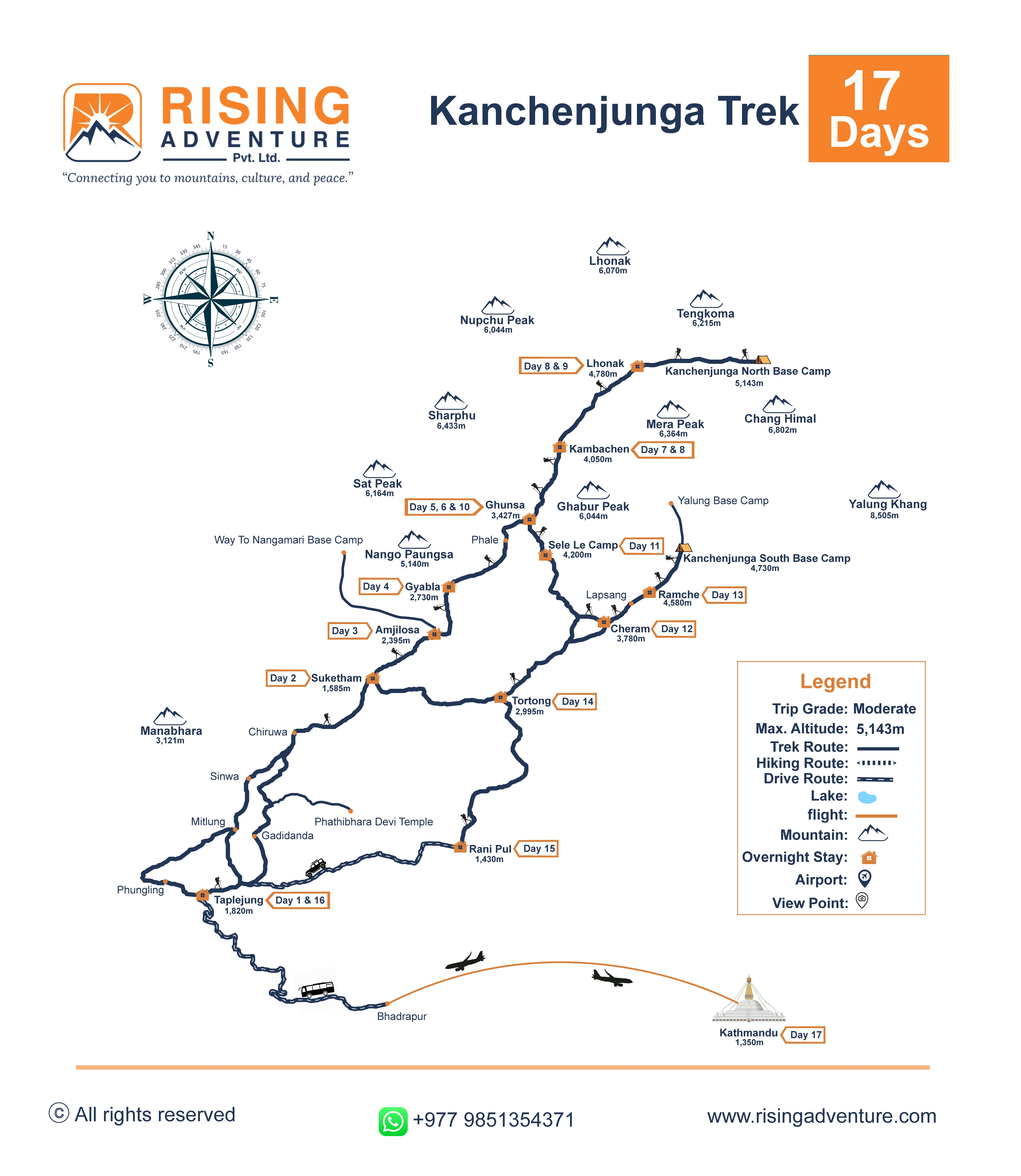
Map
Altitude Chart
Private Trip
Equipment Lists for Kanchenjunga Trek Nepal
Kanchenjunga Circuit Trekking Gears
Below are the tentative lists of Kanchenjunga Circuit trek equipment.
Upper Body Layers
- Outer Warmer Jacket
- Base layer Jacket
- Waterproof Rain Jacket
- Down Jacket
- Windproof jacket
- Fleece-type Jacket
- Trekking Shirt
- Inner windproof Thermal gloves
- Outer Gloves
Lower Body Layers
- Inner body and leg Thermal
- Rain Trousers
- Windproof pants
- Sports Underwear
Footwear & Accessories
- Hiking Boots
- Trekking Boots
- Gaiters
- Hiking Socks
- Warm Thermal Socks
Head & Sun Protection
- Sun Hat
- Warm Beanie
- Warm Scarf
- Sunscreen
- Sunglasses
Personal & Medical Kits
- Medicine, if you are taking
- First Aid Kit (Our guide keeps)
Travel Documents
- Passport
- Nepal Visa
- Two passport-size photos
- Travel Insurance
Miscellaneous
- Trekking Bag
- Duffel Bag (Rising Adventure provides)
- Light Day Bag
- Small Waist Money Purse
- Sleeping Bag
- Trekking Poles
- Headlight
- Water Bottle
- Towel
- Toilet Papers
- Waterproof Bag Cover
- Lock for Bags
- Lip Gloss
Essential Information
Meals on the Kanchenjunga Circuit Trek
The foods served during your Kanchenjunga trek will be simple yet nourishing. We make sure that the food served throughout the trek is healthy, hygienic, and full of nutrition. You will mostly find Nepali dal bhat tarkari (rice, lentils, and veggies) in the teahouses along the trail. The menu will have Nepali, Indian, and Tibetan as well as Western dishes. Momo (dumplings), noodles, soups (garlic soup, veggie soup), and pasta will be available for your lunch and dinner. The food options will get limited as you reach higher remote regions.
Accommodations during the Kanchenjunga Trekking
The accommodations during the Mount Kanchenjunga trek will be in local teahouses/lodges with basic facilities. During your stay in lower regions like Kathmandu, Bhadrapur, and Taplejung, you will find yourself in a comfortable hotel with amenities like showers, WiFi, private rooms, and restrooms. For most parts of your Kanchenjunga trek itinerary, your stay will be in basic teahouses with limited facilities and shared bathrooms. However, they will help you to get warmth and have enough rest for the next day’s journey.
Best time for Kanchenjunga Circuit Trek
Spring (March to May) and autumn (late September to November) seasons are the most appropriate times for the Kanchenjunga Circuit Trek. These seasons are characterized by good weather, clear skies, and moderate temperatures, which are ideal for trekking.
During the spring season, the trails along the Kanchenjunga region are decorated by lush green forests with rhododendron blooms. This time also presents a clear and beautiful Himalayan scenery. The daytime temperature is moderate in this season, ranging from 10 to 20°C in lower regions. However, it can get cold in the higher elevations, with temperatures reaching -5°C.
Similarly, the autumn season offers trekkers one of the clearest and best mountain panoramas of Mount Kanchenjunga and several other peaks. The daytime temperature is also very suitable, ranging between 8 and 18°C. The nights can be cold in the higher regions, with temperatures falling up to -8°C or lower.
The winter season (December to February) and monsoon season (June to August) will present a quieter and less crowded trail but have their own set of challenges. The winter season can get very cold in the higher-altitude regions, with temperatures dropping to -15°C at night. Whereas the monsoon season is not considered an ideal season for trekking in the Kanchenjunga region due to several factors like slippery and muddy trails and risks of landslides.
Mt. Kanchenjunga Trek difficulty
The Mount Kanchenjunga trek can be classified as a challenging trek. Several factors, like lengthy trek duration (about 3 to 4 weeks), long trekking hours (4 to 7 hours a day), rugged and remote trekking routes, and altitudes reaching above 5000 m, make this a strenuous one. With significant altitude gains, there is a great risk of getting altitude sickness. To complete the trek, trekkers need to properly acclimatize to the altitude by staying hydrated, walking at a steady pace, and having enough rest days between the treks. This trek is usually best suited to trekkers who have past trekking experience and strong physical fitness and mental resilience.
Kanchenjunga Trekking Permits
- The Kanchenjunga Conservation Area Project (KCAP) and the Restricted Area Permit (RAP) are the mandatory permits that are required in the Kanchenjunga circuit trek as well as the Kanchenjunga Base Camp trek.
- Kanchenjunga Conservation Area Project (KCAP): The permit is authorized by the Nepal Tourism Board. To obtain the permit, you are required to pay 30 USD per person. This permit is needed to support projects like sustainable tourism development and endangered wildlife protection.
- Restricted Area Permit (RAP): As the Kanchenjunga region is a restricted area, trekkers are compulsorily required to acquire this permit. This permit supports the preservation of the local culture and exquisite nature of the region. The trekkers need to pay 20 USD per week per person to receive this permit.
All the permits required for the Kanchenjunga circuit trek are issued and collected on your behalf by Rising Adventure, so you can have a trouble-free trek in the Kanchenjunga region.


We're Here to Help 24/7
Meet Your Local Experts
Creating unforgettable journeys across Nepal, Tibet, and Bhutan.
At Rising Adventure, we believe in connecting you to mountains, culture, and peace. As your trusted local travel partner, we create safe, authentic, and unforgettable trekking, climbing, and tour experiences across Nepal, Tibet, and Bhutan. With experienced local experts and personalised service, we're with you every step of your journey, from your first enquiry to your final departure, ensuring a smooth, memorable, and truly unforgettable experience of a lifetime.