

The Langtang Valley trek is one of the most fulfilling treks in Nepal, taking you to the pristine surroundings of the Langtang National Park. Even though it is not as well-known as the Everest Base Camp trek or the Annapurna Circuit trek, the Langtang trek offers beautiful views of the Himalayas and a captivating cultural experience.
Langtang Trek Nepal
Trip Facts
Duration
8 Days
Trip Grade
Level 1 - Easy
Country
Nepal
Maximum Altitude
4983 m
Starts
Kathmandu
Ends
Kathmandu
Group Size
2-10
Activities
Trekking
Best Time
March-May, Sept-Nov
The trek is a shorter one and can be undertaken in 8-10 days. With that being said, trekkers do have the option to extend their itinerary by having extra acclimatization days or taking a detour to the sacred Gosaikunda Lake. En route, we will go through beautiful forests, visit several monasteries and yak cheese factories, and stay in charming teahouses/lodges.
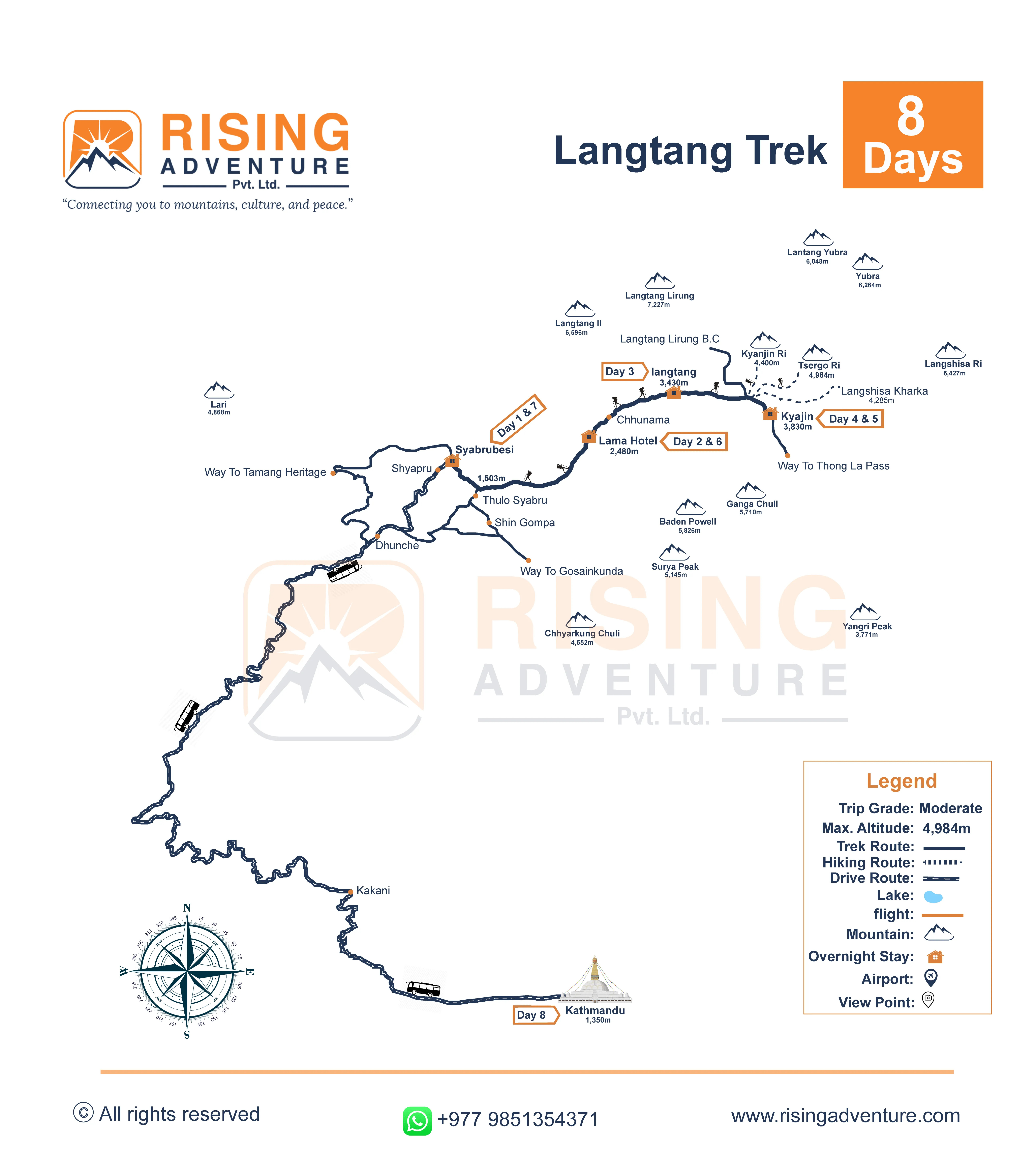
We will start our journey to the Langtang Valley with a beautiful drive starting from Kathmandu to Sybrabubesi. We will trek to the Lama Hotel from Sybrubesi through the lush forests alongside the Langtang River. Then, we will ascend to Ghodetabela while enjoying the incredible views of the Himalayas.
Next, the road will lead to the Langtang Village that was restored by the determined locals after the 2015 earthquake. At the beautiful village of Kyanjin Gompa, we have a great opportunity to see the famous monasteries and visit the local cheese factory. We can also hike to the viewpoints, like the Tserko Ri (5,033 m), to have amazing views of Langtang Lirung, Dorje Lakpa, Yala Peak, and other towering mountain ranges.
The trek to Lantang is perfect for a quiet and calm trekking experience. Beginners as well as experienced trekkers can complete the Langtang trek. The Langtang Valley trek in Nepal is an ideal trekking destination among trekkers who desire to enjoy the beauty of nature and mountain scenery as well as experience the authentic village lifestyle and culture of Nepal.
Why trek to Langtang Valley with Rising Adventure?
The Langtang Valley Trek with Rising Adventure is a safe, well-organized, and enriching Himalayan experience under the supervision of well-trained local guides. Our trekking itinerary to the Langtang Valley is well-designed with emphasis on proper acclimatization, a steady pace, and a unique cultural experience inside the Langtang National Park.
Rising Adventure offers quality service, local knowledge, and authentic hospitality with licensed guides, personalized services, and a commitment to responsible and sustainable tourism. Traveling with Rising Adventure is not a great time trekking in the Langtang region, but we will also contribute directly to the local communities.
You'll Explore It
Short Itinerary & Altitudes
Day 1:
Drive from Kathmandu to Syabrubesi
Altitude: 1,550m
Day 2:
Trek from Syabrubesi to Lama Hotel
Altitude: 2,470m
Day 3:
Trek from Lama Hotel to Langtang Village
Altitude: 3,430m
Day 4:
Trek from Langtang Village to Kyajin Gompa and Hike to Kyanjin Ri
Altitude: 3,870m
Day 5:
Acclimatization day at Kyajin Gompa and Hike to Tserko Ri
Altitude: 3,870m
Day 6:
Return to Lama Hotel from Kyajin Gompa
Altitude: 2,470m
Day 7:
Trek from Lama Hotel to Syabrubesi
Altitude: 1,550m
Day 8:
Drive back to Kathmandu
Altitude: 1,350m
Langtang Trek Nepal Detailed Itinerary
Day 1
Drive from Kathmandu to Syabrubesi
After having our early morning breakfast, we take a drive from Kathmandu and reach Syabrubesi, which will normally take around 7-8 hours. We will stop by Trishuli Bazaar for our lunch. From there, we get glimpses of the towering peaks such as Ganesh Himal and Langtang.
Our journey will pass alongside the Trishuli River, where the road might be bumpy or under construction in some sections. The scenic drive will offer the natural beauty of the lush forests, terraced farmlands, and stunning Himalayan views.
Altitude: 1,550m (5,085ft)
Duration: 7 hours
Meals: Breakfast, Lunch, Dinner, & Seasonal Fruits
Accommodation: Tea House
Mode of Transportation: Local Bus
Day 2
Trek from Syabrubesi to Lama Hotel
The trek to Langtang Valley starts with crossing the Bhote Koshi River. We will climb towards Bamboo alongside the Langtang Lirung river. The trail follows through lush forest, terraced farmlands, and small settlements. We might even spot the endangered red panda in the wilderness. We will then take a gentle ascent to Rimche, where we will have our lunch. We will then continue moving forward to Lama Hotel, the stop for our overnight stay.
Altitude: 2,470m (8,103ft)
Duration: 6 hours
Meals: Breakfast, Lunch, Dinner, & Seasonal Fruits
Accommodation: Tea House
Day 3
Trek from Lama Hotel to Langtang Village
Today, we will move early in the morning and ascend towards Ghodetabela (which translates to Horse Table). At Ghodetabela, we will see an army checkpoint of the Langtang National Park along with a few lodges. The trek then continues to Langtang Village, our destination for today.
We can observe community health posts, schools, markets, and monasteries in the Langtang village, which is mostly inhabited by the Tamang people.
Altitude: 3,430m (11,253ft)
Duration: 6 hours
Meals: Breakfast, Lunch, Dinner, & Seasonal Fruits
Accommodation: Tea House
Day 4
Trek from Langtang Village to Kyajin Gompa and Hike to Kyanjin Ri
Our trek will start at about 7 o'clock in the morning, and it will take us on an uphill route to the village of Mundu. We will follow the trail to prayer flags, Tibetan inscriptions engraved on rocks, and large chortens. The distance to the Kyajin Gompa will be about 5 km, and it will take about 3-4 hours to reach there.
While in Kyajin Gompa, you can either go sightseeing around the villages or go on a hike to Kyanjin Ri peak (4,773 m) for acclimatization. You can get a stunning close-up view of the Langtang Lirung and the Langtang mountain range from the peak. We will head back to Kyajin Gompa for the overnight stay.
Altitude: 3,870m (12,696ft)
Duration: 7-8 hours
Meals: Breakfast, Lunch, Dinner, & Seasonal Fruits
Accommodation: Tea House
Day 5
Acclimatization day at Kyajin Gompa and Hike to Tserko Ri
We are going to spend another day in Kyajin Gompa. We may visit local monasteries and the Kyajin Cheese factory to taste the locally produced cheese. Alternatively, we can go on a hike to one of the popular peaks of the area, Tserko Ri (4983 m).
When we reach Tserko Ri, we will be rewarded with magnificent views of over 20 mountains, including Langtang Lirung, Langtang Himal, and Langshisa Ri. We will also be able to have spectacular views of the Langtang Valley and the frozen lakes.
Altitude: 3,870m (12,696ft)
Meals: Breakfast, Lunch, Dinner, & Seasonal Fruits
Accommodation: Tea House
Day 6
Return to Lama Hotel from Kyajin Gompa
Leaving Kyajin Gompa, we begin our descent towards Ghodatabela. We will stop here for our lunch and register our exit at the army checkpoint. The journey continues with a steep downhill walk, which can get harsh on our knees. The use of trekking poles and taking careful steps would be critical in this scenario. In the late afternoon or evening, we shall arrive at Lama Hotel, where we will stay overnight.
Altitude: 2,470m (8,103ft)
Duration: 7-8 hours
Meals: Breakfast, Lunch, Dinner, & Seasonal Fruits
Accommodation: Tea House
Day 7
Trek from Lama Hotel to Syabrubesi
It is our last day of trekking in the Langtang region. Our descent will be through the bamboo, rhododendron, and oak trees alongside the Langtang Khola. Crossing Bhote Koshi Khola, we finally reach Syabrubesi. This is where we have a good rest for the night and prepare our return journey to Kathmandu for tomorrow.
Altitude: 1,550m (5,085ft)
Duration: 5 hours
Meals: Breakfast, Lunch, Dinner, & Seasonal Fruits
Accommodation: Tea House
Day 8
Drive back to Kathmandu
We will go back to Kathmandu on a scenic trip beginning at Syabrubesi, along the Trishuli River. This will be a long trip with few stops. Once we arrive in Kathmandu, we will be transferred to the hotel. We will celebrate our successful Langtang Valley trek by having a farewell dinner together with the Rising Adventure team.
Altitude: 1,350m (4,429ft)
Duration: 7 hours
Meals: Breakfast and Farewell Dinner
Accommodation: 3 star hotel
Mode of Transportation: Loca Bus
Need Help Planning?
Let our local experts plan your perfect journey across Nepal, Tibet, and Bhutan.
Map
Altitude Chart
Private Trip
Add-Ons & Options
You can hire a private vehicle for a more comfortable and faster road trip to Syabrubesi.
Equipment Lists for Langtang Trek Nepal
Langtang Valley Trekking Gears
Below are the tentative lists of Langtang Valley trek equipment.
Upper Body Layers
- Outer Warmer Jacket
- Base layer Jacket
- Waterproof Rain Jacket
- Down Jacket
- Windproof jacket
- Fleece-type Jacket
- Trekking Shirt
- Inner windproof Thermal gloves
- Outer Gloves
Lower Body Layers
- Inner body and leg Thermal
- Rain Trousers
- Windproof pants
- Sports Underwear
Footwear & Accessories
- Hiking Boots
- Trekking Boots
- Gaiters
- Hiking Socks
- Warm Thermal Socks
Head & Sun Protection
- Sun Hat
- Warm Beanie
- Warm Scarf
- Sunscreen
- Sunglasses
Personal & Medical Kits
- Medicine, if you are taking
- First Aid Kit (Our guide keeps)
Travel Documents
- Passport
- Nepal Visa
- Two passport-size photos
- Travel Insurance
Miscellaneous
- Trekking Bag
- Duffel Bag (Rising Adventure provides)
- Light Day Bag
- Small Waist Money Purse
- Sleeping Bag (optional)
- Trekking Poles
- Headlight
- Water Bottle
- Towel
- Toilet Papers
- Waterproof Bag Cover
- Lock for Bags
- Lip Gloss
Essential Information
Accommodation during the Langtang Valley Trek
Your accommodation on the Langtang Valley Trek will be in local teahouses or lodges. The rooms are usually twin-sharing with standard bedding and shared bathrooms. You can enjoy meals and get warmth near the stove in the communal dining areas. Private rooms with attached bathrooms are available but must be booked in advance. Trekkers can also opt for camping, though it is a less common option for the trek.
The toilets are usually squat style, with a few lodges in the lower altitude having Western-style toilets. Electricity for charging your electronic devices and hot showers is also available, but will be accessible at an additional cost. WiFi is available in some teahouses; however, the connection can be unstable.
Meals on the Langtang trek
Teahouses along the trail of Langtang Valley serve a wide variety of nutritious and hygienic meals. The menu will have options of Nepali, Tibetan, and some Western foods. You will find traditional Nepali dishes such as dal bhat tarkari along with Tibetan bread, momo, noodles, soups, rice dishes, pasta, pancakes, and eggs.
As altitude increases, food choices become more limited, but meals remain nourishing and filling. You should also try hot drinks like tea, coffee, ginger lemon honey, and garlic soup, as they help with hydration and acclimatization. We do not encourage you to consume alcohol, drinks with caffeine, or dairy products at high altitude.
Best Time to do the Langtang Valley Trek
The most favorable times for the Langtang Valley Trek are during spring (March to May) and autumn (late September to November). These seasons present trekkers with mostly stable weather, clear blue skies, and great visibility of the Himalayan peaks in the Langtang Valley.
The trails during these seasons are generally dry and sturdy, creating very suitable trekking conditions.
Monsoon (June to August) and winter (December to February) are marked by quiet and less crowded trails for the trekkers. During the monsoon, there is frequent rainfall with slippery trails. There is a strong chance of landslides in this season. Meanwhile, the winter season brings snowfall and cold weather conditions. Trekkers need to be very careful while doing treks during these periods.
Weather and Temperature of Langtang Valley By Season
Spring Season (March to May)
Spring is one of the peak seasons for trekking to Langtang Valley. The weather is very stable, with rhododendrons blooming in the lush forests along the trail. The temperature during the daytime normally ranges from 10°C to 20°C at lower elevations like Syabrubesi. While the higher altitude areas like Kyanjin Gompa have temperatures between 5°C and 12°C. The night is cold during this season, with temperatures reaching 0°C or below.
Monsoon/summer season (June to August)
This season is characterized by heavy rain. At lower altitudes, such as Syabrubesi, the rainfall occurs frequently (almost daily). The temperature ranges from 15°C to 25°C during the daytime on sunny days. You can expect temperatures of -5°C or below during the night and morning in regions above 4000 m.
Autumn Season (late September to November)
Autumn is a wonderful season for the Langtang Trek. The post-monsoon period brings clear visibility of the Himalayan ranges. The weather is favorable; that’s why it is the most preferred season for many trekkers. The temperature at lower elevations is between 10°C and 20°C during the daytime. At higher elevations, the temperature varies from 5°C to 10°C during the daytime. The temperature drops to 0°C or below at night, especially in late autumn.
Winter (December to February)
The winter season is not a preferred season for trekking due to extreme cold weather and snowy trails. At lower elevations, the daytime temperature ranges from 5°C to 15°C. The temperature falls in the range of 0°C to 5°C as we climb and enter the higher altitude regions. The nighttime temperature can drop to -10°C or even less.
Langtang Valley Trek Difficulty: What to Expect
The Langtang Valley Trek is regarded as an easy-to-moderate trek and can be done by a beginner with a decent level of fitness, as well as seasoned trekkers. The trek involves walks of approximately 5-7 hours daily, comprising gradual ascents with some steep sections that are manageable. The trail is often in good condition in the peak trekking seasons.
Our highest point on the trek will be Kyanjin Gompa, 3,870 m, which can be extended to Kyanjin Ri (4,773 m) and Tserko Ri (4,983 m) peaks. The risk of altitude sickness can be reduced by ensuring that you are well acclimatized, walk at a steady pace, and stay well hydrated. The Langtang Valley Trek is a relaxing and satisfying Himalayan experience that usually does not push you to extreme physical limits.
Permits required for Langtang Valley Trek
For the trek to Langtang Valley, you will need two main permits. They are the Langtang National Park Entry Permit and a TIMS (Trekkers’ Information Management System) card.
The Langtang National Park Entry Permit can be obtained from the Department of National Parks & Wildlife Conservation in Bhrikuti Mandap, Kathmandu. You can also acquire it at Dhunche. The permit allows you to explore the protected areas of Langtang National Park.
The Trekkers’ Information Management System or TIMS card is not required for trekkers who are traveling with a licensed guide via a registered trekking agency. However, if you are doing the Langtang Valley trek in Nepal without a licensed guide, you must have the TIMS card.
All the necessary permits are arranged and acquired by Rising Adventure on your behalf, so you can fully enjoy the Langtang trek without any issues. You will need to provide a copy of your passport and two passport-sized photos to obtain the permits.


We're Here to Help 24/7
Meet Your Local Experts
Creating unforgettable journeys across Nepal, Tibet, and Bhutan.
At Rising Adventure, we believe in connecting you to mountains, culture, and peace. As your trusted local travel partner, we create safe, authentic, and unforgettable trekking, climbing, and tour experiences across Nepal, Tibet, and Bhutan. With experienced local experts and personalised service, we're with you every step of your journey, from your first enquiry to your final departure, ensuring a smooth, memorable, and truly unforgettable experience of a lifetime.