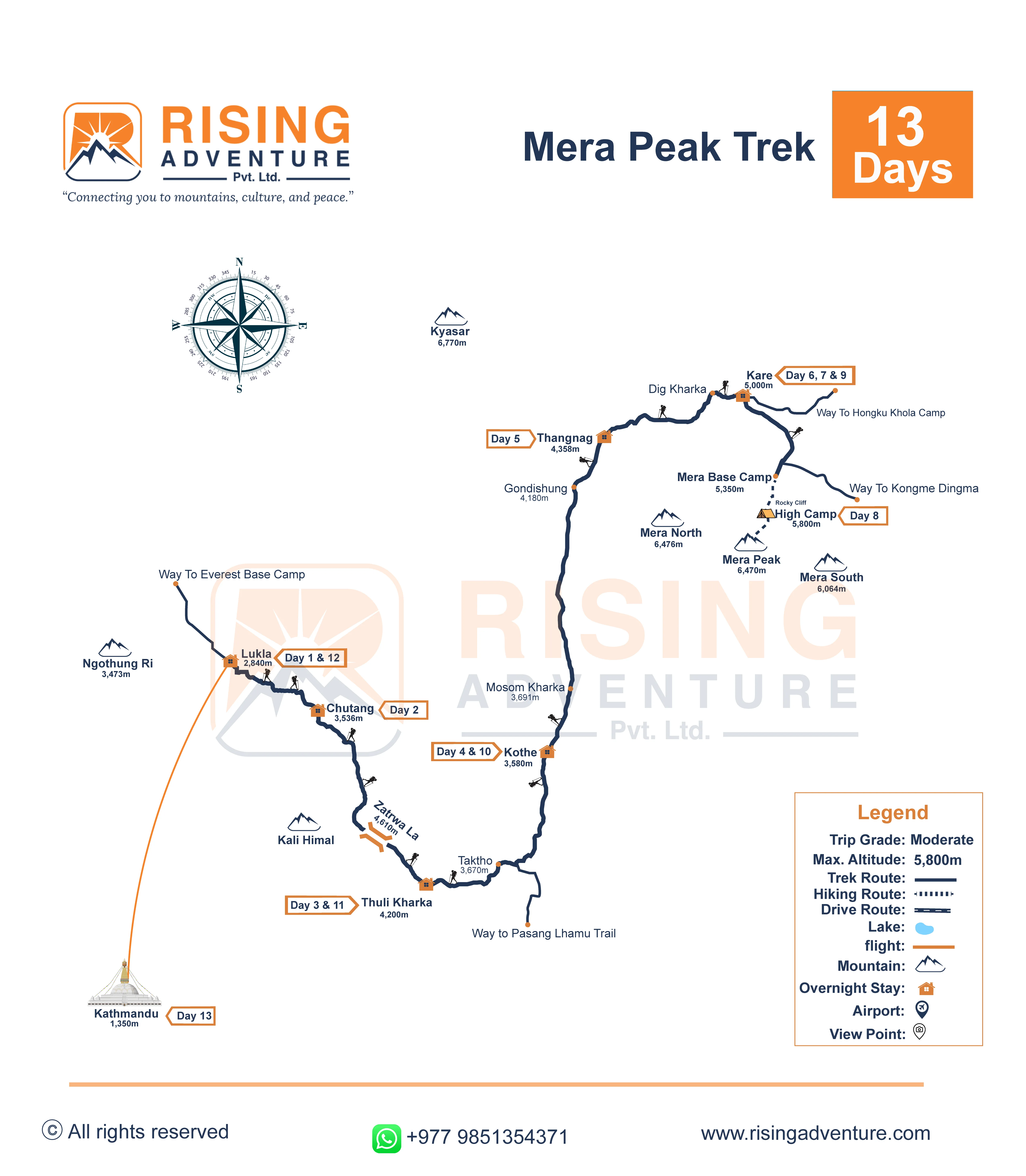
Standing on the historic land of Mount Everest, the tallest trekking peak of Nepal, Mera Peak, is the topmost destination for climbing starters around the world. The mountain is located in the Mahalangur section, Barun sub-section of the Himalaya and managerially in Nepal's Sagarmatha Zone, Sankhuwasabha, and Makalu Barun National Park. The Mahalangur section is the north-most part of the Solukhumbu region of Nepal. Since its opening, the peak provide ground to the mountaineers.
There are three main summits height of Mera; North, Mera Central, and Mera South. The height of Mera peak is often given as 6,654 meters (21,831 feet) and is called to be the highest hiking peak. The north Mera peak is 6,476 meters (21,247 feet) tall while Mera Central is 6,461 meters (21,198 feet tall and Mera South is 6,065 meters (19,898 feet) tall. It is one of the most crowded and renowned climbing peaks with an easy route. It is also a perfect acclimatization peak if you are preparing to climb Mount Everest or any of the major mountains in the Khumbu Region. The trail is sheltered, and the area is wild and unspoiled, with very few human settlements. Most nights, you will be sleeping at teahouses located at isolated Kharkas or summer camps of yak herders.
Best Time to climb Mera Peak
The climate and temperature are one of the most significant variables to witness when selecting the package to Mera Peak nobody is past nature. Picking the right time makes your planning, arrangements, and hard work get the desired result. Climbing Mera Peak at the wrong time is the simplest way to put all of your all efforts in the vain. Among all of these reasons, the best time to climb the Mera peak is considered to be spring and autumn.
During spring the flowers start to bloom, the sky is completely clear from nightfall till daybreak, the stormy climate speaks and thick sun-blocking mists likewise blur. The Magic of clear sky blue skies gives magnificent views. Not only that, the trees are full of leaves and the beautiful sound of birds chirping from dawn through dusk adds more beauty to the trek. While trekking you can also see Rhododendron flowers covering lots of forests in the lower altitudes. The temperature during the daytime remains around an average of 10 degrees Celsius. While during the night time it may drop to an average of – 4 degrees Celsius. Thus, the temperature during the spring is likewise flawless with daylight being warm and the earth after diving off the sun isn't as cold as in different months.
Autumn is another popular season to trek in this region. The autumn season includes the months of September, October, and November. October marks the best month to travel the mountains. Monsoon creates a lot of waterfalls and during this season you will find the air even fresher. Thus, you can witness the vegetation and landscapes washed by the rain of the monsoon. The temperature of this season remains around 12 degrees Celsius during the day. While the temperature falls during the night for sure.
The off-season for the Mera peak climbing is winter and summer. During the winter the region experiences heavy snowfall, thus climbing toward the peak might be difficult. The season stays throughout December, January, and February. The temperature reaches below -20°C during the coldest hours of the season. The cold is bone-chilling around -30°C in the higher part of the Mera peak.
Similarly, summer is also off-season for peak climbing. The summer is also known as the Rainy and Monsoon season. Hence, during this season the region experiences heavy rainfall and it stays in the month of June, July, and August. Thus, sometimes the wettest trail makes your trek more difficult. The average temperature during this season revolves around 15°C in the daytime. However, many people climb the mountain to test their luck despite the difficulties. One benefit of the off-season is that the trails will be quite empty. It’s a bonus for a solitude lover like you.
Overall, the peak is considered to be one of the best trekking that is available in Nepal. Knowing the right time to trek is always best for one. So if you want to have an amazing experience while climbing the peak make sure that the plan is spring and autumn. So make plans according to the season.
Routes of Mera peak climbing
Well, Mera peak is an exciting and scenically stunning peak that is considered to be popular and the highest trekking peak located in the Khumbu region. To reach there are several peak climbing itineraries that offer you a lifetime adventure experience in Nepal.
Route 1
The starting point of this route is Lukla, the gateway of the Khumbu valley. Following the Lukla, you will pass through the culturally rich like Panguam, Nagindingma, and Kothe as you pass through the isolated region of Hinku valley. After several days of the trek, you will reach a charming village named Thagnak at an elevation of 4358 m. After that, you will walk towards another village named Khare which is at an elevation of 5045m from the sea level. Likewise, the Khare is widely famous as an acclimatization location. Here the trekking companies offer basic mountaineering instruction to prepare climbers for the last push to Mera Peak. This one route is one of the most common and crowdest routes among other routes.
Route 2
Apart from the usual path for Mera Peak Climbing, you can also finish this climbing voyage through the Everest Base Camp route. Like Route 1, the starting point of the trek is also Lukla. After getting to Lukla, your next destination will be Namche Bazaar. Beautiful Namche is one of the highest trading hubs in the world. Following the Bazaar you will head towards Mera Base Camp, then to High Camp, and ultimately to the summit.
Route 3
Compared to the above route is one of the most difficult Mera Peak climbing routes and the shortest of the bunch. If you are a beginner then the route is not you because the journey takes more steps. Your journey will begin from Lukla and follow until you reach Zatra La Pass which is at an elevation of 4,610m. The trails lead you to the gorgeous valley, Hinku valley which is less crowded and peaceful. Furthermore, you will reach Mera Base Camp via Thagnak. This route is also prohibited since there aren’t adequate acclimatization days. You will arrive at Lukla and reach the Zatra La pass within two days after starting your trip.
All in all, from the summit you will see the spectacular view of the Namche and Khumbu regions. As we mentioned a couple of times before, it is not doesn't require high technical mountaineering skills, but the altitude makes it an adventurous and challenging climb. Further, you need to gather some needed permits before heading towards the climbing journey. The costs of the permits we have mentioned earlier in the above sub-headings.
How to Prepare for Mera Peak Climbing?
The best groundwork for tomorrow is doing your best today. The same rule applies to peak climbing as well. Successful Mera Peak Climbing is all about preparation. Proper training, good health, and firm determination are very basic prerequisites for dealing with the Himalayan wilderness. Thus in the case of Mera peak, we have done some amazing research on the below lists;
Basic Mountaineering Training Course
Climbing a peak is not walking miles on a straight road. If you are wandering to climb the peak it is not easy as you have to go through steep and technical sections and cross the glaciers, rugged cliffs, or ice walls. However, it is always best to have some basic knowledge and mountaineering training, and special skills in handling ice axes. Similarly, Mera peak climbing needs numerous climbing gear and well-equipped clothes. The unpredictable weather of the Mera peak region is one of the biggest challenges that climber face. So pack things according to and select clothes that are very comfortable.
Hence, if you are a beginner climber you must join some mountaineering training courses. It is very wise to learn some basic skills;
Daily Gym Work and Training
As we have mentioned above summiting Mera Peak is not that much easy. Without proper and specific training is meaningless. The summit of the peak is above 6000m, thus you will be traveling to the high altitude along with the up and downhill trails. As we all know that at high altitudes the level of oxygen is also low. To overcome this problem you must have to think about serious training. Aerobic training, hiking training, Strength Endurance training, etc. must not be ignored.
Strength Endurance Training
Strength Endurance training is one of the most recommended training. If you do Squats, step-aerobics, and luges every day it will help you a lot while climbing the peak. Similarly, you can do pull-ups, back, sit-ups, shoulder presses, and shoulder flies. The low level at the high altitude weakens your body. Thus overcoming all of these activities you can do the above-mentioned activities.
Aerobic Training
Another important training to climb the Mera peak is Aerobic or Cardio Training. It focuses on developing the endurance capacity of your lungs, heart, and structure of your body. Training includes jogging, walking, cycling, running, and swimming. This will help you help to improve your breathing and heart capacity.
Well, you can also do training on the stair master and incline treadmill. Aerobics helps you to perform at higher heart rates for longer and helps your body to adapt to the high altitude.
Hiking Training
Like most Aerobic exercises, trekking helps decrease your risk of heart disease, high blood pressure, high cholesterol, stroke, and even some cancers. While climbing the Mera peak you will also be walking across glaciers wearing heavy boots and crampons. Similarly, you will be carrying a 25 to 30-kg bag. So hiking will help manage your weight and make your journey easier.
Adequate Acclimatization
Many Mera trek itinerary has some days for Acclimatization. That will help to avert altitude sickness because it plays a vital role in the success of your high-altitude climb. At Khare at an elevation of 4950 m, you will spend three might to adapt to the environment. Thus, while traveling to Mera peak, put some spare days in case of Bad weather and side trips and Hiking. Acclimatization days are also significant as your leader will show you the basic techniques of using the equipment.
Mental Preparation
Side by side physically one must have a strong mind. It is very important to do mental preparation while climbing the Mera peak. During the trial, you may get bushed on the trails. The dark realm of the death zone might discourage you time and often. Thus, you might need a positive attitude and mental strength to keep moving onward. Physical training pays greatly to refining your mental stamina. Having great group support from trekking partners and staff also give you positive vibes. Being confident about your venture is key to your success.
Diet
A healthy diet is essential for good health and nutrition. It protects you against many chronic non-communicable diseases, such as heart disease, diabetes, and cancer. Eating a variety of foods and consuming less salt, sugars, and saturated and industrially-produced trans-fats, are essential for a healthy diet. The Mera peak climbing requires a high requirement of energy. Thus proper diet is a must for your physical fitness.
Similarly, during high-altitude treks like Mera Peak climbing, your body will be losing water due to the heat generated in your body. You need to keep drinking water to prevent altitude sickness too. It is prescribed to drink 4 to 5 liters of water on a daily basis. As well know that food is the key factor to keeping our body against physical work. Thus, have plenty of food that contains a proper diet, and do not forget to drink water.
Offerings of Mera Peak climbing
If you are an explorer keenly fascinated by mountaineering, Mera Peak Climbing could be your breakthrough point. It is an excellent option for anyone with moderate mountaineering experience and one of the most challenging trekking peaks due to its elevation, but the technical mountaineering skills requirement is very basic. Despite being so difficult the trek will reward you will a jaw-dropping view of Everest, Kanchenjunga, Lhotse, Cho Oyu, and Makalu. Apart from that, here are some offerings of the spectacular Mera Peak:
- Bright visibility of five mountains above 8,000m including Everest, Makalu, Kanchenjunga, Lhotse, and Cho Oyu.
- Reach the astonishing altitude of Mera Peak (6,476m/21,246 ft).
- Walk through the Khumbu Valley and the infrequently visited Hinku Valley.
- Get the audacious and wannabe feat of trekking and technical climbing.
- Visit magnificent places like Zatre La Pass, Thagnak, Khare, Mera La, Chutenga, Chatrarbu, Kothe, etc.
- Familiarity with the wilderness through old-fashioned villages and the rich local cultures of Hinku Valley
- Attractive high peak pass of Zatrwa La and several glaciers
- A brilliant option for the ones with reasonable climbing training and involvement.
- Revenue the shortest route to climb Mera Peak. This 14 days itinerary is the straight Mera Peak Climbing Itinerary.
- A straightforward route to the summit with minimal technical climbing
- Climb with a guide who has Mount Everest summiteer with more than 20 years of mountaineering experience.
- Unique food and Sherpa people.
- Enjoy the pink, purple, red, and white Rhododendrons in bloom (in spring)
- Chirping of birds and witnessing different wildlife.
- Lukla is a gateway to the Khumbu region, here you can visit the local people, Hillary school, monasteries, and so on.
- Similarly, you will visit the Namche bazaar where you can see how the trade works there and the Tibetan culture.
Overall, despite being so tough the trek will be worth it once you try. It is a great introduction to high-altitude climbing and the most appropriate practice climb before attempting other challenging mountain expeditions. The climbing section is easy and safe because of the fixed lines, so we highly recommend this climb even for a beginner who needs to climb an ice peak.