

The Tamang Heritage Trek takes us to the Langtang region situated in the northern part of Nepal. It is one of the nearest and cultural treks in Langtang from Kathmandu, Nepal. The trek offers Himalayan trekking as well as the cultural exploration of the Tamang Community in the Lantang Valley. The strong Tibetan influences in the Tamang communities are reflected through the Buddhist culture. We will see several monasteries, prayer wheels, and mani stones during our trek in the Langtang Valley.
Tamang Heritage Trek Nepal
Trip Facts
Duration
12 Days
Trip Grade
Level 2 -Moderate
Country
Nepal
Maximum Altitude
4983 m
Starts
Kathmandu
Ends
Kathmandu
Group Size
2-10
Activities
Trekking/Hiking
Best Time
March-May, Sept-Nov
The Tamang Heritage Trail is situated in the formerly restricted areas near the Tibetan border. The trek travels through several Tamang communities, such as Gatlang and Thuman, before leading to the classic route of the trek to Langtang Valley.
Our journey to the cultural trek in Langtang begins as we set off on a scenic drive from Kathmandu to Syabrubesi. We will pass through several Tamang villages such as Gatlang, Tatopani, Thuman, and Briddim, and learn about their distinct culture and lifestyles. In Tatopani, we also get the chance to take a rejuvenating bath in the natural hot springs.
We will then head towards Lama Hotel, from where the classic route of the Langtang trek will begin as we move towards Langtang village and finally to Kyanjin Gompa. We will visit several ancient Buddhist monasteries and also get the opportunity to savor the locally produced yak cheese at the Kyanjin Gompa Cheese Factory.
We will go on a hike to Tserko Ri too, which will reward us with the panoramic views of numerous towering peaks such as Langtang Lirung, Langtang Himal, and Langshisa Ri.
The trail throughout the Tamang Heritage and Langtang Valley Trek winds through dense forests with several rhododendrons blooming, terraced farmlands, and beautiful villages.
The Tamang Heritage Trek is a moderate-level trek, suitable for travelers who want to experience the natural beauty of the Himalayas as well as immerse themselves in the rich culture of the Tamang people in the Langtang region.
You'll Explore It
Short Itinerary & Altitudes
Day 1:
Drive from Kathmandu to Syabrubesi
Altitude: 1,450m
Day 2:
Trek from Syabrubesi to Gatlang
Altitude: 2,200m
Day 3:
Trek from Gatlang to Tatopani
Altitude: 2,607m
Day 4:
Trek from Tatopani to Thuman
Altitude: 2,338m
Day 5:
Trek from Thuman to Briddim
Altitude: 2,229m
Day 6:
Trek from Briddim to Lama Hotel
Altitude: 2,470m
Day 7:
Trek from Lama Hotel to Langtang Village
Altitude: 3,430m
Day 8:
Trek from Langtang Village to Kyajin Gompa
Altitude: 3,870m
Day 9:
Rest day at Kyanjin Gompa
Altitude: 3,870m
Day 10:
Trek from Kyanjin Gompa to Lama Hotel
Altitude: 2,470m
Day 11:
Trek from Lama Hotel to Syabrubesi
Altitude: 1,460m
Day 12:
Drive back to Kathmandu
Altitude: 1,350m
Tamang Heritage Trek Nepal Detailed Itinerary
Day 1
Drive from Kathmandu to Syabrubesi
Our journey to the Tamang Heritage Trail begins with a scenic drive from Kathmandu to Syabrubesi. The path follows along the Trishuli River, passing through terraced farmlands, lush forests, and small towns. On a clear day, we will also get picturesque Himalayan views of Ganesh Himal, Manaslu, Annapurna I, and other peaks. The route takes us through the town of Dhunche before arriving at Sybrubesi, where we will stay overnight.
Altitude: 1,450m (4,757ft)
Duration: 7 hours
Meals: Breakfast, Lunch, Dinner, and Seasonal Fruits
Accommodation: Tea House
Mode of Transportation: Local Bus
Day 2
Trek from Syabrubesi to Gatlang
Today, our trekking journey begins from Syabrubesi, as we head towards Gatlang. First, we will make an ascent on a steep trail to reach Ronga Bhanjyang. En route, we will get stunning mountain views of the Ganesh Himal, Langtang Lirung, Gosaikunda range, and others. Our next stop will be at Goljung Village, where we will have our lunch.
We will then finally reach the traditional Tamang village of Gatlang after 3 hours of hiking. Trekkers can explore around the village to understand the daily lifestyle of the Tamang people as well as visit the sacred Parvatikunda Lake and an old monastery.
Altitude: 2,200m (7,217ft)
Duration: 4 hours
Meals: Breakfast, Lunch, Dinner, and Seasonal Fruits
Accommodation: Tea House
Day 3
Trek from Gatlang to Tatopani
We descend towards Chilime, following the gentle path through dense forests. On our way, we will be treated to stunning views of Ganesh Himal and the Langtang ranges. We can see the Chilime Hydropower Project Dam on the Trishuli River at Chilime. We will cross a suspension bridge and make our ascent through the terraced farms to arrive at Gonggang.
After climbing further, we will finally reach the Tatopani village. "Tatopani" is a Nepali word that translates to hot water. We get the opportunity to have a relaxing bath in the natural hot springs of Tatopani. We will spend our night in Tatopani.
Altitude: 2,607m (8,553ft)
Duration: 6 hours
Meals: Breakfast, Lunch, Dinner, and Seasonal Fruits
Accommodation: Tea House
Day 4
Trek from Tatopani to Thuman
On today’s journey of the Tamang Heritage trek, we head towards Thuman from Tatopani via Nagthali. The trail winds through dense forests before arriving at Brimdang. We will then reach Nagthali Hill after trekking for a few hours. At Nagthali, we can enjoy incredible views of Ganesh Himal, Kerung Himal, Sanjen Himal, and Langtang Lirung.
We will then make our descent to the Tamang village of Thuman. As the village is close to Tibet, the daily lifestyle, traditions, and heritage of the Tamang people in Thuman evidently reflect strong Tibetan influences.
Altitude: 2,338m (7,670ft)
Duration: 6 hours
Meals: Breakfast, Lunch, Dinner, and Seasonal Fruits
Accommodation: Tea House
Day 5
Trek from Thuman to Briddim
We will make our descent towards Lingling, where we will stop by for our lunch. We will also cross the Bhote Koshi Khola on our way. Then, the path follows an ascent leading to Briddim. Briddim is a popular Tamang village in the Tamang Heritage Trekking, strongly influenced by Tibetan culture. During our stay in Briddim, we can visit local monasteries and stupas around the area, notably Dukchu Gomba.
Altitude: 2,229m (7,312ft)
Duration: 6 hours
Meals: Breakfast, Lunch, Dinner, and Seasonal Fruits
Accommodation: Tea House
Day 6
Trek from Briddim to Lama Hotel
After having our morning breakfast, we descend towards Ghopche Khola. We will cross the Ghopche Khola and ascend to Lama Hotel, traversing through the Rimche and Bamboo villages. Today’s path winds through the lush forests and terraced farmlands along the Langtang River. If we are lucky, we might also spot the rare red panda on our way. We will have our overnight stay in the Lama Hotel.
Altitude: 2,470m (8,103ft)
Duration: 6 hours
Meals: Breakfast, Lunch, Dinner, and Seasonal Fruits
Accommodation: Tea House
Day 7
Trek from Lama Hotel to Langtang Village
Our trek navigates through different landscapes as we begin our walk along the rhododendron and pine forests to an open Langtang valley following Thyangsyapu. We will then head towards Ghoda Tabela, translating to "Horse Table" in English. We will see an army checkpoint of the Langtang National Park at Ghoda Tabela, where we will register our permits.
Traveling further, we reach Langtang village, inhabited by the Tamang people. The Langtang village was greatly affected by the 2015 earthquake. The resilient people of the Tamang community have rebuilt the village, making it easier for trekkers to stay over.
Altitude: 3,430m (11,253ft)
Duration: 6 hours
Meals: Breakfast, Lunch, Dinner, and Seasonal Fruits
Accommodation: Tea House
Day 8
Trek from Langtang Village to Kyajin Gompa
Today will be a short and easy trek to Kyajin Gompa. The route will traverse through Mani walls, prayer flags, yak pastures, and small villages. Kyajin Gompa offers stunning views of the Himalayas in the Langtang region. We will roam around the Kyanjin Gompa village or take a hike to Kyanjin Ri peak, which offers spectacular panoramic views of Langtang Lirung and the Langtang mountain range.
Altitude: 3,870m (12,696ft)
Duration: 4 hours
Meals: Breakfast, Lunch, Dinner, and Seasonal Fruits
Accommodation: Tea House
Day 9
Rest day at Kyanjin Gompa
This day is scheduled as a rest day and to further explore the place of Kyanjin Gompa. Today is going to be an exciting day as we visit the Kyanjin Gompa monastery and explore the local cheese factory to taste the locally made yak cheese.
Alternatively, we can also set out on a hike to Tserko Ri. From the Tserko Ri Peak, we can get marvelous views of 20+ mountains, including Langtang Lirung, Langtang Himal, and Langshisa Ri. Besides, we will also be rewarded with amazing views of the Langtang Valley and the frozen lakes.
Altitude: 3,870m (12,696ft)
Meals: Breakfast, Lunch, Dinner, and Seasonal Fruits
Accommodation: Tea House
Day 10
Trek from Kyanjin Gompa to Lama Hotel
We will return to Lama Hotel today. The route will retrace back to Langtang Village and Ghoda Tabela. We will have our lunch at Ghoda Tabela and have a short break before resuming our trip. We shall then pass through the thick forests and the mountain river and reach Lama Hotel to spend the night.
Altitude: 2,470m (8,103ft)
Duration: 6 hours
Meals: Breakfast, Lunch, Dinner, and Seasonal Fruits
Accommodation: Tea House
Day 11
Trek from Lama Hotel to Syabrubesi
This will be the last day of the Tamang Heritage and Langtang Valley trek. We will pass through the thick rhododendron and oak forests alongside the Langtang River, leading to Syabrubesi. We will take our lunch here, celebrate our successful journey, and start our preparation for returning to Kathmandu.
Altitude: 1,460m (4,790ft)
Duration: 6 hours
Meals: Breakfast, Lunch, Dinner, and Seasonal Fruits
Accommodation: Tea House
Day 12
Drive back to Kathmandu
Having completed our last breakfast of the trek, we will travel back to Kathmandu through a scenic drive. Our trek ends with Rising Adventure after reaching Kathmandu.
Altitude: 1,350m (4,429ft)
Duration: 7 hours
Meals: Breakfast and Farewell Dinner
Accommodation: 3 star hotel
Need Help Planning?
Let our local experts plan your perfect journey across Nepal, Tibet, and Bhutan.
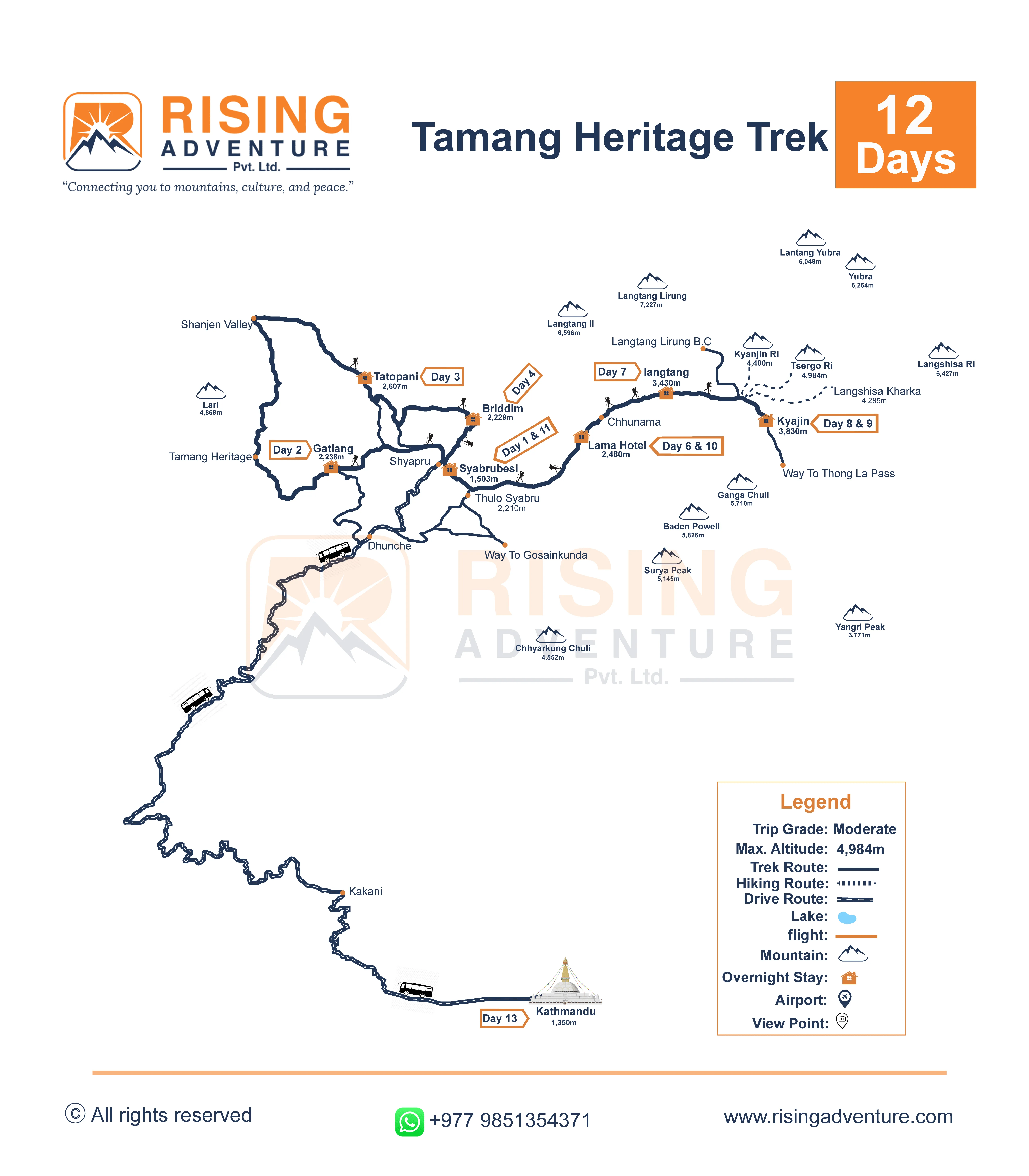
Map
Altitude Chart
Private Trip
Add-Ons & Options
You can hire a private vehicle for a more comfortable and faster road trip to Syabrubesi
Equipment Lists for Tamang Heritage Trek Nepal
Tamang Heritage Trail Trekking Gears
Below are the tentative lists of Tamang Heritage trek equipment.
Upper Body Layers
- Outer Warmer Jacket
- Base layer Jacket
- Waterproof Rain Jacket
- Down Jacket
- Windproof jacket
- Fleece-type Jacket
- Trekking Shirt
- Inner windproof Thermal gloves
- Outer Gloves
Lower Body Layers
- Inner body and leg Thermal
- Rain Trousers
- Windproof pants
- Sports Underwear
Footwear & Accessories
- Hiking Boots
- Trekking Boots
- Gaiters
- Hiking Socks
- Warm Thermal Socks
Head & Sun Protection
- Sun Hat
- Warm Beanie
- Warm Scarf
- Sunscreen
- Sunglasses
Personal & Medical Kits
- Medicine, if you are taking
- First Aid Kit (Our guide keeps)
Travel Documents
- Passport
- Nepal Visa
- Two passport-size photos
- Travel Insurance
Miscellaneous
- Trekking Bag
- Duffel Bag (Rising Adventure provides)
- Light Day Bag
- Small Waist Money Purse
- Sleeping Bag (optional)
- Trekking Poles
- Headlight
- Water Bottle
- Towel
- Toilet Papers
- Waterproof Bag Cover
- Lock for Bags
- Lip Gloss
Essential Information
Meals on the Tamang Heritage Trek
During your Tamang Heritage Trekking, we will serve you food that is wholesome, rich in nutrients, and hygienic. Meals are served in teahouses and local lodges, with Dal Bhat (rice and lentils with veggies) being the most common and energy-rich option for trekkers. You will have options of local Nepali foods, other Asian dishes, and some Western cuisines. The option will be limited as we trek to the higher region along the Tamang Heritage Trail.
A variety of breakfast options are available for the trek, such as tea/coffee, hot chocolate, Tibetan bread/chapati, porridge, corn flakes, toast with butter/jam/honey, eggs, pancakes, and yogurt.
For lunch and dinner, you can have Daal Bhaat (rice and lentils) with veggies, fried rice, pizza, momo, pasta, different types of soup, Tingmo, potato items, papad, prawn, Korean ramen, sandwiches, rice pudding, apple pie, and so on.
Staying hydrated at high altitude is very important. We recommend that you try hot lemon with honey and ginger, green tea, lemon tea, and garlic soups, as they help in acclimatization. Avoid drinking alcohol, caffeinated items, and hot chocolate at higher elevations.
Accommodations on the Tamang Heritage trail
On the trek, accommodation is mostly offered by the local teahouses and homestays that are basic but comfortable. Rooms are typically twin-sharing with simple beds, clean bedding, and shared bathrooms. Private rooms with attached bathrooms are available in places like Sybrubensi and Kyanjin Gompa. Your evenings will be spent being warm close to the fireplace in the dining rooms.
The warm hospitality, cultural exchange, and peaceful surroundings make the accommodation a standout of the trek. You can have access to Wi-Fi in lower areas like Syabrubesi but there might not be any Wi-Fi facilities in the higher regions. You need to pay an additional amount for a hot shower, which is available in a bucket.
Best time to do the Langtang Tamang Heritage Trekking
The most appropriate times to travel for the Tamang Heritage Trek are spring (March to May) and autumn (late September to November). Both spring and autumn present stable weather, clear blue skies, and great visibility of the mountain peaks. Winter offers a much quieter trail but the weather is very cold, especially in the higher altitude regions. Similarly, the monsoon season is not preferred for trekking due to slippery and muddy trails, low mountain visibility and the chance of landslides.
Here’s a breakdown of what trekking is like in each season.
Spring (March to May)
Spring is an ideal season for the Tamang Heritage trekking. The weather during spring (especially after mid-March) is generally stable with green dense forests and rhododendron blooms. You will get amazing views of the Himalayan peaks in the Langtang Valley, such as Langtang Lirung and Langtang II. This is the perfect time to get the best of nature as well as a rich Tamang cultural experience.
Autumn (late September to November)
Autumn is another appropriate and most preferred season for the trek. The weather and temperature in this season are very pleasant, with clear mountain visibility after the monsoon rain. Although the autumn season starts in September, there is a chance of rainfall in the earlier days. So, the trekking is very suitable from late September.
Winter (December to February)
This season is perfect for trekkers who want a peaceful trek along the Tamang Heritage Trail. There is a chance of snowfall in the Langtang region. The days and nights are very cold during this season, especially in higher regions. The temperature drops during this time make it very unpleasant for trekking.
Monsoon/Summer (June to August)
The season brings heavy rainfall, which makes the trail very muddy and slippery. The mountain visibility is also heavily affected by rain. The chances of landslides are very high during this season. The monsoon is not a preferable season to trek around the Langtang National Park region.
Langtang Tamang Heritage Trek Permits Detail
You will need to have two main permits to do the trek. They are
- Langtang National Park Permit
- TIMS (Trekkers’ Information Management System) card
The Langtang National Park permit is mandatory for all trekkers, which will cost around 25 USD. There will be discounts for citizens of SAARC member countries. The TIMS card is also required for trekking in the Langtang Valley. You need to carry the permits with you all the time during your trek.
All the permits are handled and obtained by Rising Adventure on your behalf. You just need to provide a copy of your passport and two passport-sized photos to us.
Tamang Heritage Trek Difficulty
The Tamang Heritage Trek is considered to be an easy to moderately challenging trek. You will need to walk for long hours while also making an ascent in some steep sections. Beginners with good fitness can also do this trek. Although you are not going as high as the Everest Base Camp, acclimatization to the high-altitude areas such as Nagthali is essential to avoid altitude sickness. Walking at a steady pace and staying hydrated is very crucial for proper acclimatization. This is a perfect trip for travelers who want a cultural as well as natural Himalayan experience of Nepal.


We're Here to Help 24/7
Meet Your Local Experts
Creating unforgettable journeys across Nepal, Tibet, and Bhutan.
At Rising Adventure, we believe in connecting you to mountains, culture, and peace. As your trusted local travel partner, we create safe, authentic, and unforgettable trekking, climbing, and tour experiences across Nepal, Tibet, and Bhutan. With experienced local experts and personalised service, we're with you every step of your journey, from your first enquiry to your final departure, ensuring a smooth, memorable, and truly unforgettable experience of a lifetime.