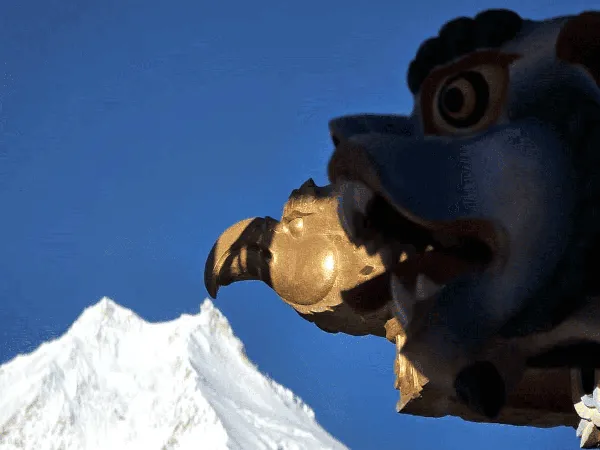
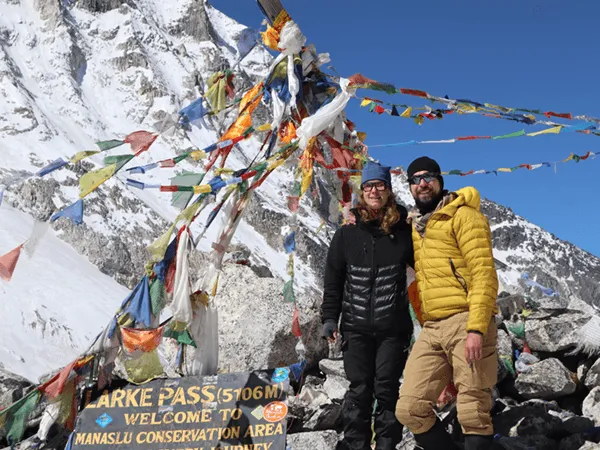
Mountains that can be seen during the Manaslu circuit trek
Mount Manaslu
Mount Manaslu is the eighth-highest mountain in the world. It is obvious that during the trail you will see a giant big peak which is at an altitude of 8,163 meters. The Manaslu name is derived from the Sanskrit word Manasa which refers to the mountain of the Spirit. Each year, thousands of people come here just to see the spectacular sights of the snow-capped mountain.
Larkey peak
Another spectacular mountain that you will witness and have to climb during the Manaslu circuit trek is Larkey Peak. The peak is considered to be a challenging peak in Nepal. It is located at the Manaslu Himalayan range at a height of 6219 meters or 20398 feet.
While climbing the peak, you will be able to explore the rich culture of the local community of the Manaslu area and the spectacular geography near the Tibetan village. During the Larkey peak climb, you will also have to cross an attractive mountain pass i.e. Larkya la at an elevation of 5200m. The pass is famous as the world’s longest trekking pass which can be done without the use of any climbing gear.
Himlung Himal
Himlung Himal is another mountain that you will witness during the Manaslu circuit trek. 7126 m tall peak is located in Nepal's western region just above the ancient Tibetan village of Phu in the Naar-Phu region in the northeast of Annapurna and northwest of Manaslu. The peak is considered to be one of the safest and most rewarding peaks in Nepal. The climb of Himlung Himal through the typical course represents no specialized issues. The trail leads through day snow and ice with no stone climbing sections. The climbing season is in the fall and spring.
Cheo Himal
During the Manaslu circuit trek, you will witness the spectacular sights of Cheo Himal. The beautiful Himal is situated at 6,820m above sea level, in the Peri Himal range in Manang district west Nepal. Cheo is about 3 km far from Himlung. The mountain was climbed by the Japanese Shigeki Imoto, Nepalese Ful Bahadur Rai, Tshering Sherpa, and Dambar Bahadur Gurung in 1992 from the southeast ridge.
Gyaji Kang
Gyaji Kang is one of the most notable peaks during the Manaslu circuit trek. It is at an altitude of 7,038 meters and situated nearby to the localities Nemjung Goth and Himlung. The trek takes you through the remote Tibetan setting villages of Nar and Phu on the Tibet border in the most northern part of Manang, Nepal. This will help you to learn more about the culture, tradition and so on. This area was very lately explored so it is known to limited climbers only. Therefore very few teams have climbed this peak.
Nemjung
Nemjung is located approximately 150 kilometers northwest of the Nepalese capital Kathmandu and about 25 km northwest of the eight-thousander, Manaslu. The summit of the Nemjung is at an elevation of 7,140 meters above sea level. The peak was first climbed on October 27, 1983, via the east edge by a joint expedition from the Hirosaki University Alpine Club and Nepal led by Junji Kurotaki.
Kang Guru
Kang Guru is another gorgeous mountain that is located in the Manang region of Gandaki Province. The summit of the Kang Guru is at an elevation of 6981m above sea level. The peak is one of the highest peaks of the Larkya sub-range of the Nepalese Himalayas. Furthermore, the Larkya range lies northwest of Mansiri Himal and northeast of the Annapurnas. Thus, while on the Manaslu circuit trek, make sure to ask your guide which one is Kang Guru.
Annapurna II
Annapurna II is another giant peak that you will witness during the Manaslu Circuit Trek. It is a part of the Annapurna mountain range located in Nepal and is the eastern anchor of the range. Moreover, it is the 16th-tallest mountain in the world and the second-highest peak of the Annapurna mountain range. The peak was first ascended by a British/Indian/Nepalese team led by J. O. M. Roberts via the West Ridge, reached by hiking the North face of Annapurna IV in 1960. The summit of Annapurna II is at an elevation of 7937m above sea level.
Mt. Hiunchuli
During the Manaslu circuit trek, one can observe the rich culture of the local people with the majestic views of the mountain. You will be able to see the shiny snow-covered mountain of Hiunchuli. It is situated in the Annapurna massif of the Gandaki Province in north-central Nepal. Furthermore, Hiunchuli is the extension mountain of the Annapurna South. There is a narrow section of the Modi Khola valley between the Hiunchuli and Machapuchhare. The valley is also an access point to the Annapurna Sanctuary. The peak was first climbed by the U.S. Peace Corps volunteer Craig Anderson in 1971.
Mt. Ganesh
Not only Manaslu, Annapurna, you will be able to witness Mount Ganesh, which is a sub-range of the Himalayas located mostly in north-central Nepal, but some peaks lie on the border with Tibet. The summit of the Ganesh is at an elevation of 7422m. The highest peak in Ganesh Himal is Mount Ganesh I i.e. Yangra.
Manaslu Conservation Area
Manaslu Conservation Area (MCA) was established in October 1998 by the Nepal government. It encompasses an area of 1663 square kilometers. It aims to preserve natural resources and the rich cultural heritage. It also promotes ecotourism to improve the livelihood of the local people of the Manaslu region.
MCA is home to different rare habitats and floras. It preserves 33 species of mammals, 11 species of butterflies, 3 different sorts of reptiles, and 201 kinds of birds. There are 11 kinds of forests, more than 50 kinds of useful plants like herbs and shrubs, as well as almost 2000 species of plants.
Apart from them, Manaslu Conservation Area covers the villages like Sirdibas, Chhekampar, Chumchet, Bihi, Prok, Lho, and Samagaun. MCA is divided into three different geographical regions on the basis of ethnicity and nature. They are Nubri Valley, Tsum Valley, and the Kutang. The altitude goes up from almost 600 meters to the top of Mt. Manaslu at an elevation of 8,163 meters above sea level. As a result, the climate changes from place to place.
The Samagaun, Prok, and Lho come under the Nubri Valley lies in the northwestern part of the Manaslu Conservation Area. On the other hand, Chumchet and Chhekampar are included in the Tsum Valley, which lies in the northeastern part and the Bihi is only one village that comes under Kutang. Among these valleys, the Nubri and Tsum have their own distinctive features and are mainly popular valleys of the Manaslu region. The former is typically famous for Buddhist education where many monks and nuns live there. You can explore the historic Buddhist Monasteries. But the latter is popular for the Tibetan Buddhist culture which is situated nearby the border between Nepal and Tibet.
Before 2001, no any tourist got permission to enroll in the Manaslu region. Then the Nepal government handed over the responsibility of MCA management to the NTNC for 10 years and later extended the time again for 10 years. It means 20 years in total aiming to upgrade tourism in the Manaslu sector and improve the lifestyle of the local communities.
Before, the Manaslu area was deprived of basic services including safe drinking water, electricity, schools, and hospitals. As well as the development of infrastructure was also neglected. So, they depended on animal husbandry, natural resources exploitation, and non-technical agriculture. Therefore, NTNC started to work out the program named as Manaslu Ecotourism Development Project. NTNC worked in cooperation with the Nepal Government and the Asian Development Bank under the Ministry of Culture, Tourism, and Civil Aviation's Second Tourism Infrastructure Development Project.
Many field programs were held and implemented to motivate and increase the locals' capacity and enhance their leadership for managing the natural heritages. Now, the MCA is being managed by the Integrated Conservation and Development Program (ICDP) approach which emphasizes on the management of natural resource sustainability.
However, the prime objectives behind the establishment of the Manaslu Conservation Area are listed below;
- To manage and preserve the natural resources and the cultural heritage of the Manaslu region
- To upgrade the eco-tourism in order to improve the lifestyle of local inhabitants
Things to do in Manaslu Conservation Area
- Trekking
- Mountaineering
- Bird Watching
- Red Panda Tracking
- Snow Leopard Tracking
- Himalayan Thar, etc
Some places to visit in the Manaslu Conservation Area
- Larke La Pass
- Tsum Valley
- Samagaun
- Pungyen Monastery
- Birendra Lake, etc
Some names of Protected Mammals
- Red Panda
- Musk Deer
- Snow Leopard
- Gray Wolf
- Protected Mammals
- Lynx
- Leopard Cat
- Tibetan Brown Bear
- Himalayan Bear
- Assamese Monkey, etc
Some names of Protected Birds
- Impeyan Pheasant
- Crimson Horned Pheasant, etc
Please step gently into the fragile Himalayan land of the Manaslu region and follow some rules for maintaining the natural and cultural heritage. They are;
- Do not disturb the wildlife and their habitats
- Do not damage or remove any plants
- Do not purchase animal parts and antiques
- So not light open fires
- Support the local economy in the best possible way
- Use and encourage alternative energy sources for firewood
- Make sure that you and your trekking support crews do not burn firewood for heating
- Dispose of rubbish properly at the proper sites
- See that your trekking support staff does the same
- Carry out all other non-biodegradable and toxic rubbish
- Use a water purifier instead of plastic mineral water bottles
- Ask permission to photograph people
- Do not give anything to the beggers
- Avoid wearing revealing clothes and avoid outward displays of physical affection
Manaslu Circuit Trek Food and Accommodation
As it is known, Manaslu Circuit Trek lies in the remote region of Nepal. It is a less-explored place. And it is also a kind of tea house trek in the Himalayan sector of Nepal.
So, tea houses are used as Manaslu circuit trek accommodations. A tea house is like a small hotel or lodge in a mountainous area. It offers basic facilities only in the higher elevation while you can expect more facilities in the lower elevation.
All the rooms are provided on a twin-sharing basis. But you may get a single room as well in low-altitude places. Hot showering, mobile charging, attached bathrooms, and free Wi-Fi are the basic features of lower-elevation tea houses. But only a twin-shared room, a clean pillow and blanket, sharing traditional toilets, and a charging plug are offered in the higher altitude hotels in the Manaslu region.
You need to pay a small amount for mobile charging and Wi-Fi. So, we recommend you buy an online data pack from the mobile SIM card and get connected with us and your family.
Taking a small mobile charging backup may prevent you from wasting money for charging a mobile in upper elevated places in Manaslu Circuit Trek.
Regarding the food in the mountain during Mt. Manaslu Circuit Trek, you can get Nepali dishes like Daal, Bhat, Tarkari, and pickle mostly in all the hotels. But both Asian and Western foods are also served. You can get verities of meals, especially in the lower-elevation tea houses. Normally, lunch and dinner are similar, but you can have a choice.
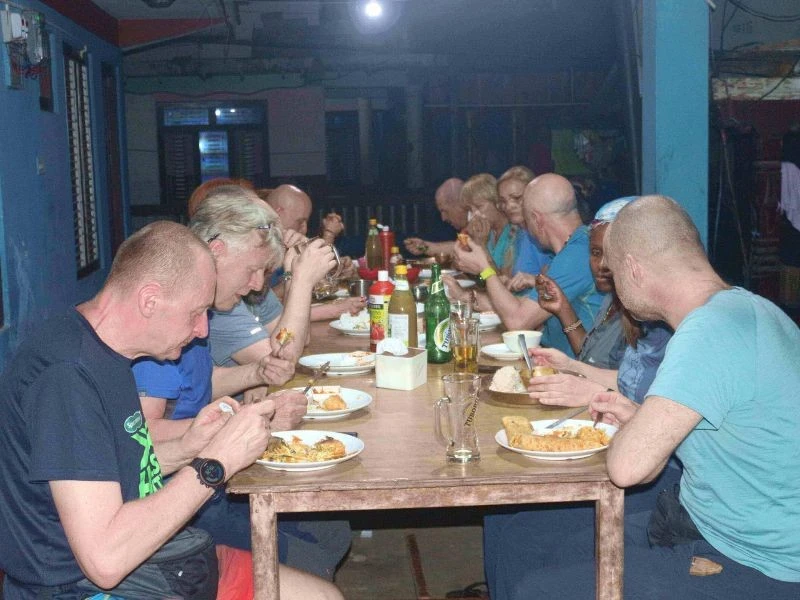
Please, read the following tentative Manaslu circuit trek food chart;
Breakfast: two boiled eggs/fried eggs, pancakes, porridge, juice, tea, coffee, Tibetan bread, toasted bread with jam, Muesli, fruits, vegetables, cornflakes, and others
Lunch/ Dinner: Rice, Lentil, seasonal vegetable, pickle, Thendug, Spaketi, Chowmein, Momos, Steak, Sherpa Stew, Macrooni, vegetable soup, non-veg soup, tomato salad, spinach salad, onion salad, mushroom soup, potatoes, Korean Ramen, Papad, Prawn, Rice pudding and apple pie as dessert, soft and hard drinks, and others.
We highly recommend you have a fresh vegetable soup for your health benefits.
Manaslu Circuit Trek Difficulty
Normally, the Manaslu circuit trek is considered one of the moderately strenuous trekking destinations in Nepal. Because you are going to cross the Larke La Pass over 5000 meters above sea level. It is very tiring to cross the Pass. But the outstanding Himalayas views, unspoiled natural features, and diverse ethnic cultures encourage you to complete the entire trekking.
Manaslu circuit trek difficulty depends on some of the factors that appear during trekking. Such as high altitude sickness, long walking distances, unpredictable weather, remote landscapes, and heavily loaded backpacks.
However, all our guides are Nepal government-certified licensed holders. They are first aid trainers as well.
Besides, most of our guides and porters belong to the Himalayan region of Nepal. And we always send them on trips related to their living zone because they know technically well about every single trail of their area.
So, you do not need to be worried. We handle everything. We may even charter the helicopter in case of emergency. But the Helicopter hiring fees must meet your travel insurance policy.
Manaslu Circuit Trek Distance
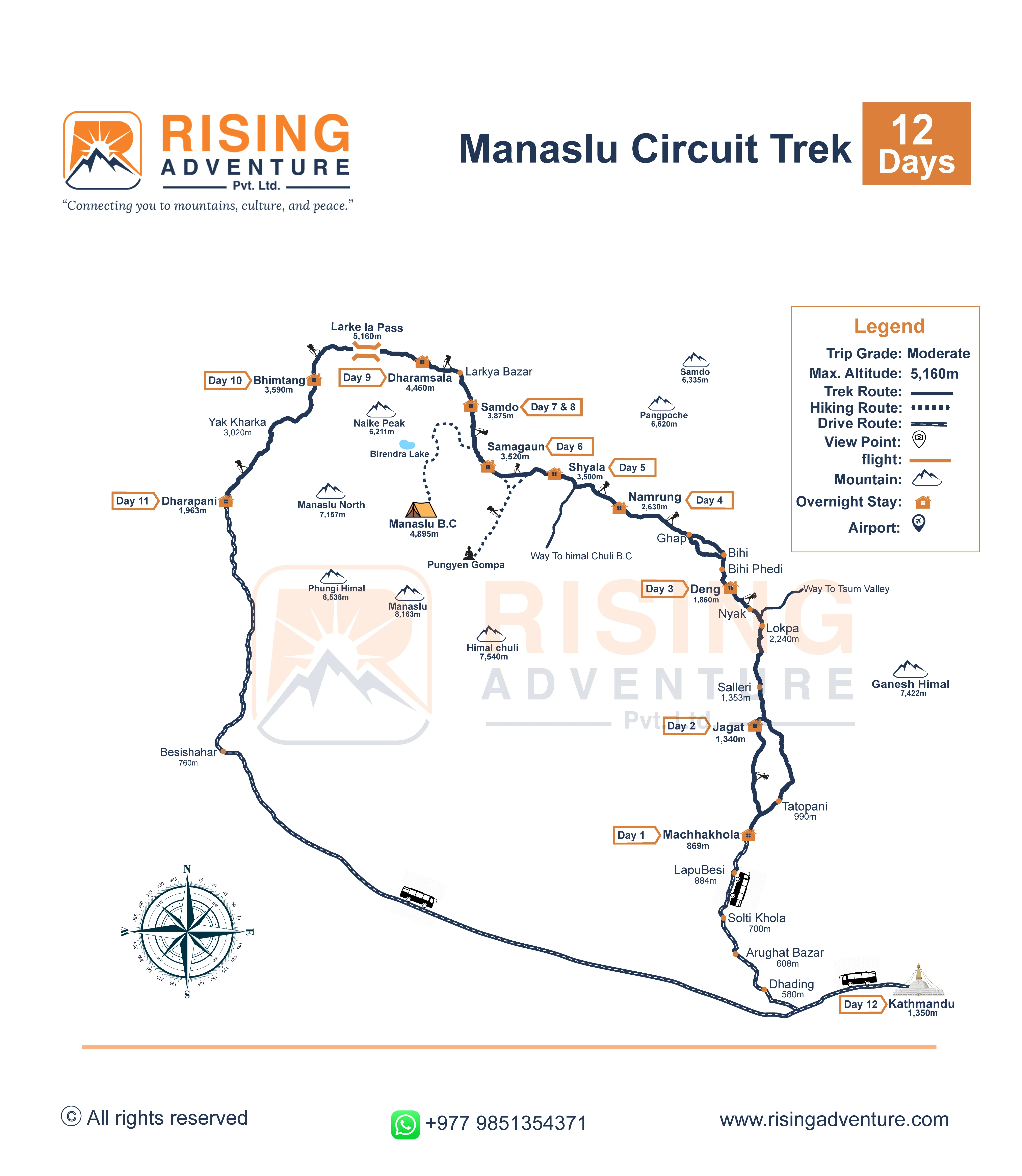
The Manaslu circuit trek distance is approximately 160 km from Sotikhola to Dhararpani. The former is the Manaslu treks Nepal starting place whereas the latter is the ending point.
Similarly, Sotikhola lies in the Manaslu region while Dharapani is located in the Annapurna region. It means, that the Manaslu circuit treks Nepal adjoin the Annapurna zone at the end of trekking. If you want you can even extend your trekking duration and join the Annapurna Circuit Trek as well within a single itinerary.
It is 14 days of Manaslu Circuit Trek in total. You need to walk for almost seven to eight hours per day. We have calculated 2 days for acclimatization.
If you are physically fit and have a high-altitude trekking experience, you can cut off the trekking days and enjoy the short round trekking to Mt. Manaslu. In the same way, we can even add more days if you require.
But you have to arrive in Nepal 2 days before your trip starts. Because the Nepal government requires your original passport for making MCAP permit card. As you know, it is a restricted area of Nepal.
However, we can customize it as per your requirements. So, please know about the distance of trekking before planning the itinerary of the circuit trek to Manaslu.
Our Licensed Guides for Manaslu Trek
We are staffed with dedicated, professional, highly qualified, and friendly guides for the Manaslu Circuit Trek. The guides at Rising Adventure have government-certified licenses and are proficient with first-aid treatment and emergency preparedness.
All our guides are closely familiar with every section of the Manaslu trek route. They all have 5+ years of experience for the Manaslu Circuit trek and have successfully crossed the Larke Pass more than 10 times along with several trekking groups throughout the years.
Akal Singh Rai
Mr. Rai is our senior trekking guide and has 12+ years of experience in the trekking industry and has led several trekking groups to the Manaslu Circuit trek successfully. He personally knows many teahouse operators along the way. He has crossed the Larke Pass around 15+ times and is highly knowledgeable about the weather conditions and safety measures to take while crossing the pass.
Sundar Thapa Magar
Mr. Thapa Magar is a highly professional trekking and mountaineering guide of our company. He has successfully completed the Manaslu trek more than 5 times while leading and managing several trekking groups throughout the year. In fact, he has also successfully summited Mount Manaslu (8,163 m), the 8th-highest peak in the world. If you are looking for a trustworthy trekking guide for your Manaslu trek, he is the right person to lead your journey.
Hari Pariyar
Hari Pariyar is yet another excellent trekking companion for your Manaslu Circuit trek. He is an experienced trekking guide who has crossed the Larkya Pass more than 10 times. He is also a very friendly and helpful guide who always gets positive feedback from trekkers who have completed the Manaslu Circuit trek with him.
Sushil Pandey
Mr. Pandey, who has served as a trekking guide for 10+ years, is a dependable partner if you are looking for a safe and enjoyable Manaslu trek. He also has successfully crossed the Larke Pass 12 times while leading the trek.
Bishal Thapa Magar
Finally, we have Bishal Thapa Magar, who is a professional, friendly, and highly experienced guide of Rising Adventure. He has crossed Larke Pass well over 5 times and is very familiar with the trekking routes and high-mountain weather conditions of the Manaslu region.
Manaslu Circuit Trek Route
Our Manaslu trek route includes many different culturally rich villages, pristine Mt. Manaslu, and pure and authentic ethnic traditions. Gurung and the Tsum are the ethnical tribes of the Manaslu region.
We have designed the Manaslu trek for 14 days including two resting days. The trek begins from Sotikhola and ends at Dharapani.
Machchha Khola, Jagat, Deng Khola, Namrung, Sama Gaun, Samdo Village, DharmaShala, Bimthang, and the Tilije are other places included in the Manaslu circuit trek route.
Larke Pass with an elevation of 5,160 meters is the most challenging walking day of the entire Manaslu trail in Nepal.
Manaslu Circuit Trek Acclimatization
Acclimatization is one of the major concerns of every trekking package. Having proper acclimatization prevents you from getting high-altitude sickness.
So, we have designed this trek to the Manaslu region concerning those acclimatization factors. We have added 2 extra days for rest.
Larke La Pass is the highest pass of the Manaslu trekking. It is situated at an elevation of 5160 meters above sea level. It is the hardest point of the entire trekking route to cross. So, you need to be well acclimatized before crossing the Larke Pass.
However, all our trained guides and porters assist you during trekking. If you get contacted with altitude sickness, our guide will take you to the lower altitude places. If it seems serious, you will be transferred to the Hospital in the capital city of Nepal. We will hire a Helicopter if the situation demands.